
How to write a brand positioning statement: template and examples
By David Herskowitz, Founder and Creative Director
Write a positioning statement with a fill-in template, worked examples, and a test for whether a competitor could claim the same line.
By David Herskowitz, Founder and Creative Director, Splash Creative. November 2, 2026.
A positioning statement is one sentence that names the customer, the category you want to be known in, the benefit you can prove, and the alternative you are different from. Write it by filling the template on this page with specifics a salesperson would actually say, then test it by swapping in a competitor's name. If the sentence still sounds true with their name in it, it is not a position yet.
The examples further down are hypothetical, labeled as such, so you can see the template filled in for ordinary kinds of businesses. The project pictures are real Splash Creative work. They show what a decided position looks like once it has to live on a card, a site, and a sales conversation. They are not sample statements we are putting in a client's mouth.
What a positioning statement is
A positioning statement is an internal sentence. It is the decision about who the brand is for and why that person should pick it. It is not the homepage headline, and it is not the line under the logo. Those get written after this sentence exists, and they have to be able to trace back to it.

Use it when a founder, a salesperson, and a designer would otherwise describe the company three different ways. The statement gives them one version. On a branding project, this is the sentence we ask you to sign off on before identity design starts. If a competitor could claim it too, it is not a position.
The sentence has a job inside the company:
- It tells a new hire who you sell to, in one breath.
- It tells the homepage which reader it is for.
- It tells a designer what the identity has to express, and what it should refuse to look like.
- It tells you when a new offer is a distraction. If the offer does not serve the customer in the sentence, it does not belong in the lead story.
Length is one or two sentences. Long enough to name the customer, the proof, and the alternative. Short enough that someone can say it on a call without reading it.
Betterness is one place this kind of decision shows up in finished work. The company sits at clinical care, personal growth, education, and community. It needed a name and an identity that felt legitimate and warm, and that did not sound like the rest of that category. The name Betterness is simple and familiar, and it is unexpected. The system that followed includes a manifesto, voice principles, taglines, and visual guidelines. The project page is the record of that work. This article does not invent a positioning line for them.
A positioning statement template you can fill in
Copy this and replace every bracket. Leave a bracket empty rather than filling it with a word any competitor could use.
For [specific customer] who [problem, in their words], [brand] is the [category] that [benefit you can prove] because [the evidence]. Unlike [the alternative they actually compare you with], we [the difference].
Each slot has a test:
| Slot | What belongs there | What to reject |
|---|---|---|
| Specific customer | A person with a situation: where they are, what they buy, what just happened. | "Businesses," "everyone," "consumers who want quality." |
| Problem, in their words | The sentence they use when they complain. A delay, a risk, a person they cannot get on the phone. | Your internal description of the product. |
| Category | The file folder a buyer already has in their head. The label they would type into a search. | A category you invented that nobody searches for. |
| Benefit you can prove | The outcome they get, stated so a skeptic can ask "how do you know?" | Trusted, premium, passionate, best-in-class. |
| The evidence | The operational fact that makes the benefit true: a cap on clients, a close date, a license, a way you staff the work. | A feeling. "We care." "We go the extra mile." |
| The alternative | The real option they compare you with: a named type of competitor, the status quo, or doing it themselves. | A villain you do not actually lose deals to. |
| The difference | The one thing that alternative cannot honestly say. | A longer list. If you need three differences, you do not have one yet. |
Two shapes are enough. The full sentence above is the one you keep in the brand doc. A shorter line, for the top of a deck, drops the "because" and keeps the customer, the benefit, and the alternative:
[Brand] helps [specific customer] [outcome] by [how], unlike [alternative].
If the short line and the full sentence disagree, the full sentence wins. The short line is a compression, not a second strategy.
Hypothetical examples
These are made-up companies, written to show the template. They are not Splash clients, and they are not case studies.
A hypothetical Bergen County pediatric practice. Parents are comparing a neighborhood office with a health-system group that books sick visits weeks out.
For parents in Bergen County who need a pediatrician they can reach when a child is actually sick, [Practice] is the local pediatrics group that holds same-week sick visits with a doctor who already knows the child, because the panel is capped and an after-school clinic is staffed every weekday. Unlike a health-system practice where the next opening is weeks out, the visit stays with the same physician.
A hypothetical bookkeeping firm for independent restaurants in New York City. The buyer is an owner who gets a PDF after the month has already closed, from a firm that also does dentists and landlords.
For independent restaurant groups in New York City that are tired of books that arrive after the month is over, [Firm] is the restaurant accounting partner that closes by the 10th and flags a food-cost spike the same week, because every client is a restaurant and the review starts with prime cost. Unlike a generalist firm that treats a restaurant like any other small business, the monthly conversation is about the kitchen, not a generic profit-and-loss.
A hypothetical specialty coffee roaster selling to offices. The buyer is an office manager replacing a pod machine, and the alternative is a national coffee service that swaps beans when the price moves.
For office managers who are done with pod machines and mystery beans, [Roaster] is the specialty roaster that puts a named lot on the menu and services the machine on a set route, because the lots are small enough to trace and the route already covers the neighborhood. Unlike a national coffee service that changes the blend when the contract price changes, the coffee on the menu is the coffee in the hopper.
Read those again and cover the brand slot. The customer, the proof, and the alternative still describe a specific business. That is the bar. "We provide high-quality service with a personal touch" fails it, for a pediatric practice, a bookkeeper, and a roaster alike.
How to write a positioning statement
Block two hours. Bring the person who sells, not only the person who writes. You are looking for the sentence the buyer already half-believes, then making it specific enough that a competitor cannot sign it.
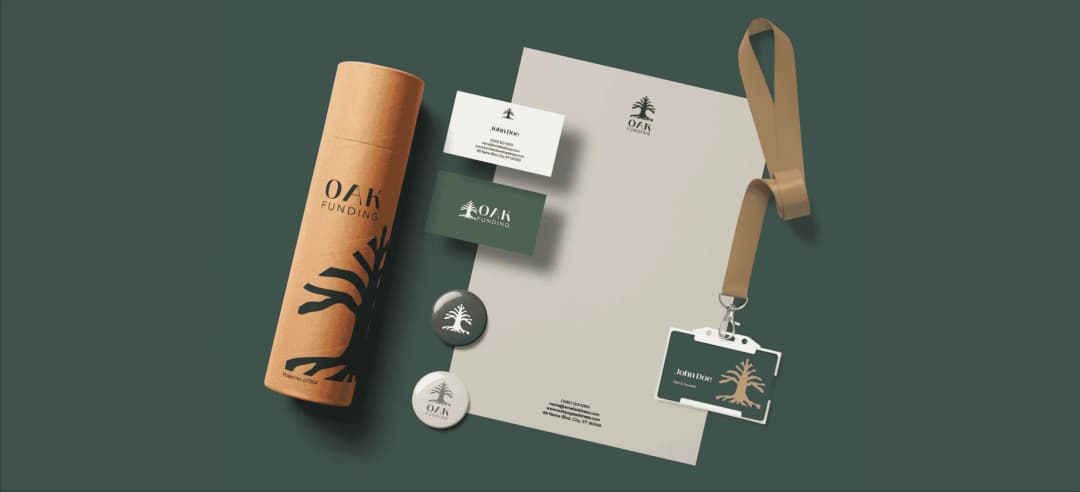
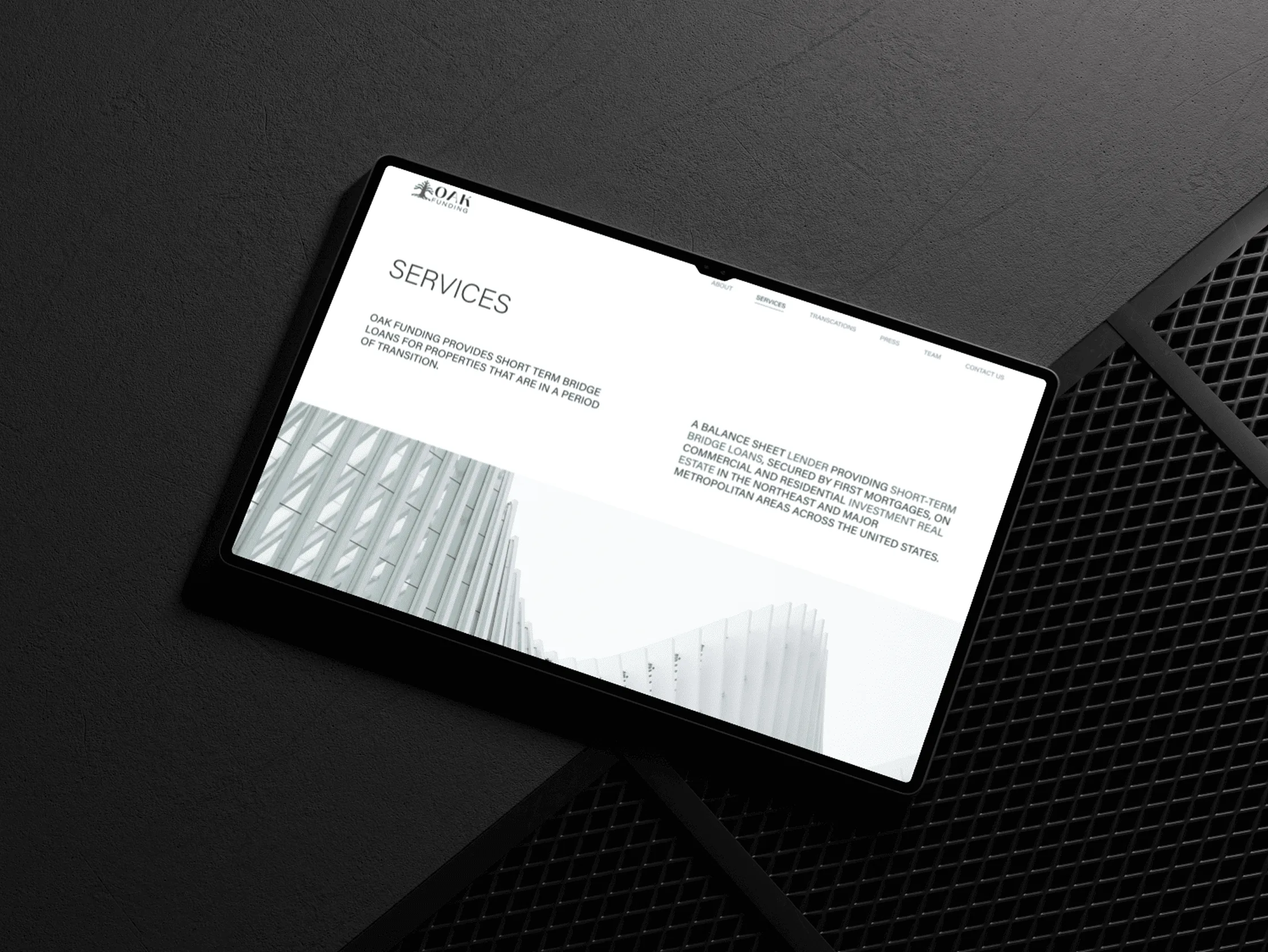
Oak Funding is a useful picture of why the sentence has to be specific. The firm offers bridge loans, mezzanine financing, and construction loans for commercial property across the NY/NJ metro area. What it has, and what a generic lender sheet does not say, is the perspective of both a property owner and a lender. That difference is what the identity was built to carry: a hand-drawn oak tree mark, a forest green and warm gold palette, and a website that gives borrowers and partners a credible home.
- Write down who actually buys. Pull the last ten wins and the last ten losses. Name the person in the room, their role, and the situation that made them look. "CFOs at companies with 50 to 200 employees" is a start. "The operator who just lost a deal because the deck looked like a smaller firm" is a customer. Use the second kind.
- Write the problem in their words. Take it from a call note, a lost-deal email, or a review. If you cannot quote a customer, you are still guessing. For the hypothetical pediatric practice, the words are "I cannot get a sick visit this week," not "access to care."
- Name the category they would search. This is the noun a buyer already uses. Pediatric practice. Restaurant bookkeeper. Office coffee service. If your category only makes sense after a paragraph of explanation, you have a messaging problem, and the positioning statement is the wrong place to invent a new industry.
- Pick one benefit you can prove this quarter. List the outcomes you are proud of. Cross off any that a competitor's site also claims. What remains is usually operational: a close date, a panel cap, a route, a license, a way the work is staffed. That is the "because."
- Name the alternative you actually lose to. Ask sales who you were compared with on the last five deals. Status quo counts. "They kept the spreadsheet" is an alternative. A famous brand you have never competed with does not.
- Fill the template, then cut. Read it aloud. Delete every adjective that does not point at the evidence. If the sentence needs a second paragraph to make sense, the customer slot is too broad or the benefit is still a slogan. Stop at one difference.
Do this in one document the whole leadership team can see. A positioning statement that lives in one founder's head will be rewritten by the next person who touches the homepage.
When the sentence is settled, the words around it can be written: the homepage, the deck, the way a salesperson opens. That next layer is brand messaging. The statement is the decision. Messaging is how the decision sounds in public.
How a positioning statement differs from a tagline, a mission, and a value proposition
These four get used as if they were the same sentence. They are written for different readers, and they fail in different ways.

| Positioning statement | Tagline | Mission | Value proposition | |
|---|---|---|---|---|
| Who reads it | Your team, your agency, your board | Anyone who sees the logo | The company, sometimes the public | The buyer, on a page or a call |
| Job | Choose the customer, the category, and the difference | Be remembered in a few words | Say why the company exists | Say what the buyer gets |
| Length | One or two sentences | Two to six words | A sentence or a short paragraph | A sentence, often with proof nearby |
| Test | A competitor cannot sign it | Someone can repeat it tomorrow | It still makes sense in five years | A buyer can tell what they receive |
A tagline can be derived from the statement. It cannot replace it. "Care, closer" might be a line for the hypothetical pediatric practice. It does not say who it is for, what "closer" means in the calendar, or what the health-system alternative fails to do. Those details stay in the statement, where the team can use them.
A mission is about purpose. "Help children grow up healthy" can be true of every pediatric practice in the state. It is a reason to exist. It is not a position.
A value proposition is the offer: what the buyer gets, often with the price, the scope, or the outcome next to it. "Same-week sick visits with the same physician" is a value proposition sitting inside the positioning statement. The statement also holds the customer and the alternative, which the offer line can leave out.
Brand messaging and brand identity split the same way. Messaging is the language. Identity is what people see. The positioning statement is upstream of both. What brand identity includes is the system you design once the sentence is agreed: logo, color, type, voice, and the rules for using them.
MetaboliK Health is a clear case of a category that looks the same until the difference is specific. It is a medical weight management platform in New York, combining FDA-approved GLP-1 medications, one-on-one health coaching, and personalized nutrition in one subscription. The space is loud, and most of the brands in it look alike. The program was rigorous, and the visual identity did not show that yet. The identity that followed had to earn credibility on sight, clinical without being cold, and the site had to explain the program, the pricing, and a qualification step. A tagline would not have done that work. The position had to say what was actually different, and the identity had to carry it.
Common mistakes
- Writing for everyone who might pay you. The first draft almost always says "for growing companies that want a partner they can trust." Trust is a hope. It is not a slot in the template. Name the situation.
- Filling "because" with a feeling. "Because we care" and "because we are passionate" cannot be checked. The evidence slot is an operating fact. If you do not have one, the work is to create one, not to find a better adjective.
- Using the tagline as the statement. A short line is easier to approve, which is why teams stop there. You then watch the website, the deck, and the sales call drift apart, because nobody wrote down the customer or the alternative.
- Positioning against the wrong rival. Comparing yourself with the largest brand in the category feels ambitious. If your losses are to a local generalist or to "we will do it in-house," that is the alternative the sentence has to beat.
- Listing three differences. A list is a brochure. Pick the difference the buyer cites when they choose you, and put the rest in a capabilities section.
- Changing it every time a competitor runs an ad. The statement should survive a quarter. If the business has actually moved (new buyer, new offer, a merger), that is a repositioning, which is a different project. How to reposition is the piece for that moment. A new ad from a rival is not.
- Approving a sentence the sales team will not say. If the closer winces, the sentence is for the brand deck only. Ask them to say it on the next call. Edit until they will.
A statement can be true and still be the wrong project to commission design against. If the position is sound and the problem is that the visual system looks dated, you may need a refresh rather than a new strategy. Rebrand or refresh is the decision. Do not throw out a sentence that is working because the logo has worn out.
How to test a positioning statement
Run these in order. Stop and rewrite when one fails. Do not "wordsmith" a sentence that fails the swap test. The slots are wrong, not the adjectives.

- The swap test. Replace your name with the competitor you lose to most often. Read it aloud. If it still sounds fair, the benefit or the evidence is generic. Go back to those two slots.
- The say-it test. Ask the person who sells to open a call with the short version, once, without the document in front of them. If they cannot, it is too long or too precious.
- The stranger test. Read the full sentence to someone who does not work in your company. Ask who it is for, and what they would get. If they describe a category and not a difference, the alternative slot is empty.
- The homepage test. Write a headline and a first paragraph that a new visitor could believe, using only facts that are in the statement. If the page needs a claim the statement does not support, either the page is overreaching or the statement is incomplete. Fix the statement first.
- The teammate test. Two people who were not in the drafting session explain the company to you, separately. You are listening for the same customer and the same difference. Matching slogans are not required. Matching choices are.
- The loss test. Hold the sentence up against the last deal you lost. If the buyer left for a reason your sentence never mentions, you have been describing the company you wish you were.
CoverWhale is the kind of brief where those tests are obvious. It is an InsurTech broker that uses data and technology to streamline trucking insurance. The audience has no patience for friction, and trust has to show up immediately. The brand and the website were built around one idea: make it fast, make it clear. The identity projects confidence and precision. The site moves a visitor to what they need, without jargon and without extra steps. "We are a modern insurance platform" would have failed the swap test in that category. Speed and clarity, tied to a buyer who will not wait, is a position you can design against.
Keep the winning sentence where the work happens: the top of the brand guidelines, the first slide of the sales deck, and the brief for anyone writing the site. A statement in a folder nobody opens is a draft.
When to bring in an agency
Write the first draft yourself. You know the customers and the losses. An agency should not invent your customer from a workshop icebreaker.
Bring in help when the draft stalls for a reason you can name:
- The founders disagree on who the customer is, and every meeting ends with "both."
- The sentence is true and still generic, and you cannot find the evidence slot.
- You are about to spend real money on an identity and a website, and you want the design to start from a sentence everyone has signed.
- The company has changed (new market, new buyer, a merger) and the old line describes the old company. That is the rebrand path, and it starts with this sentence, not with a new logo.
How we work is the sequence: understand the business, put deliverables, timing, and fees in writing, agree the direction, then make the work tangible. Research and positioning come before design when the direction is not settled yet. On a focused brand identity, where the position is already clear and the job is the visual system, the published range is 4-6 weeks. A full brand strategy and identity, which is where this statement gets decided with you, is 8-12 weeks. A website added to the same engagement is timed in the written scope.
Pricing is where those starting points are explained. Brand identity is from $15,000. A website is from $15,000. Brand strategy, identity, and website together is from $30,000. Project work is a fixed scope and a fixed fee, agreed in writing. No hourly billing on project work.
Branding is the practice this sits inside: strategy and positioning first, then logo, color, type, voice, guidelines, and the applications the brand has to survive. Brand strategy is the service when what you need is the position, the audience priorities, and the messaging, with or without a new identity in the same engagement. If your positioning is already solid, we will say so. A new project does not automatically require a new positioning exercise.
Modality Advisors is the shape of that engagement. It is a boutique strategic advisory and capital formation firm, built across advisory, execution, and capital formation rather than one lane. The job was a name, a look, and a voice that an institutional audience could read immediately. The identity is clean, authoritative, and restrained. The copy takes a complex offer and makes the positioning click. That is what "bring in an agency" should mean: the sentence gets sharp enough to design, and the design is held to the sentence.
Splash Creative is in Englewood, NJ. David Herskowitz leads the work. We meet clients in New York City and Northern New Jersey in person at the milestones where being in the room helps, and we work with clients farther away. There is no NYC office.
You do not need us for a first pass at the template. You do need a hard reader if the sentence keeps coming back generic, or if the next step is a brand and a website that will be expensive to redo.
Related: Branding · Pricing · How we work · Rebrand or refresh · Brand messaging vs. brand identity · What is brand identity
Frequently asked questions
How do you write a positioning statement?
Name one specific customer, the problem in their words, the category they would search, one benefit you can prove, the evidence, and the alternative you actually lose to. Fill the template: For [customer] who [problem], [brand] is the [category] that [benefit] because [evidence]. Unlike [alternative], we [difference]. Then swap in a competitor's name. If the sentence still sounds true, rewrite the benefit or the evidence.
What is a brand positioning statement?
It is an internal sentence that decides who the brand is for, what category it competes in, and why that customer should choose it over the alternative. Taglines, mission statements, and homepage headlines are written from it. They are not substitutes for it.
How long should a positioning statement be?
One or two sentences. It should be short enough to say on a call, and long enough to include the customer, the proof, and the alternative. A two-to-six-word tagline is a different line, written after the statement is settled.
What is the difference between a positioning statement and a tagline?
A positioning statement is for your team. It names the customer, the category, the proof, and the alternative. A tagline is a short public line people can remember. The tagline can be drawn from the statement. It cannot carry the customer and the evidence by itself.
What should a positioning statement template include?
A specific customer, the problem in that customer's words, a category they already understand, a benefit you can prove, the evidence, the real alternative, and one difference. Leave a slot blank rather than filling it with a claim any competitor could make.
How much does it cost to get help with a positioning statement?
At Splash Creative, brand identity is from $15,000, a website is from $15,000, and brand strategy, identity, and website together is from $30,000. A focused identity, when the position is already clear, is 4-6 weeks. A full brand strategy and identity is 8-12 weeks. The fee is a fixed scope and a fixed fee, agreed in writing before kickoff. You can draft the statement yourself with the template on this page.