

 Shopify store builds

In short
 In short
Shopify development at Splash Creative covers catalog and collection structure, product page and variant design, custom Liquid theme and section development, app selection and integration, Klaviyo event setup, and post-launch iteration. We choose between theme settings, a custom section, or an app based on what's lightest for the store and easiest for your team to manage. Every store is designed in Figma and approved before development starts.
- Who it is for
- Consumer brands building a new Shopify store or improving an existing one
- What it covers
- Storefront and product-page design, theme development, catalog setup, app integrations, Klaviyo connections, and custom features
- Who does the work
- A senior team led by David Herskowitz, Founder and Creative Director
- How it is priced
- Shopify store from about $20,000. Scope and fee confirmed in a written proposal

In David’s words
“Launch day isn't the finish line. It's just the first day of data collection.”

Our view
Most Shopify problems get solved by installing another app. Each one can add scripts to every page, and plenty of stores are still loading apps they stopped using a year ago. The fix is usually less, not more: a cleaner product page, a selector built into the theme, a collection structure that matches how people actually shop.
What we do instead
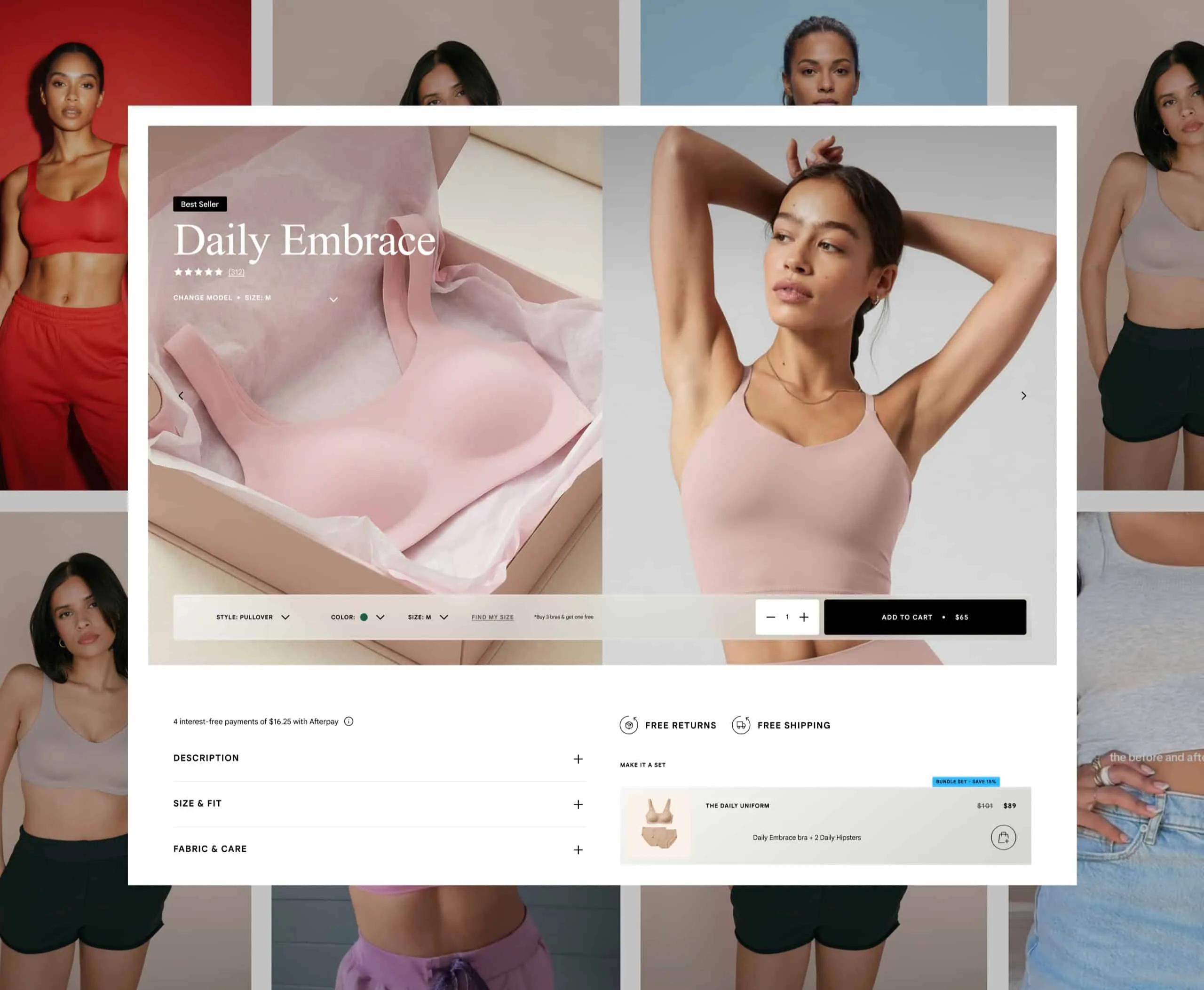
We start from the catalog, not the homepage. How do customers narrow the range: size, color, use, fit, pack size? We structure products, metafields, and filters around those answers, then design the product page to settle the questions that stop a purchase. When a feature would be lighter built into the theme than added as an app, we build it.
Where we've done it
For HUUG we built custom style selectors, pack-size logic, and product menus around the way an intimates brand actually sells. The Absolute Collagen sells one product, so its product page has to do the explaining a catalog usually spreads across dozens of pages.
What goes into a Shopify store we build
- 01
Catalog and collection structure
Products, variants, metafields, tags, and filters set up so the right items surface in a few taps. A messy catalog makes every later feature harder, so we fix it first.
- 02
Product pages that answer
What it is, how it fits or works, what shipping costs, how returns work. Those answers sit near the add-to-cart button, not buried in tabs or the footer.
- 03
Variant and size selection
Clear swatches, real size guidance, and sold-out options that look sold out. We design selectors around how the product is actually chosen, including bundles and pack sizes.
- 04
Custom Liquid sections
Sections built into your theme with settings your team can change in the Shopify theme editor. You get flexibility without another monthly app subscription.
- 05
App stack cleanup
We review every installed app, remove what's redundant, and check what each one loads. Faster pages usually start with fewer scripts.
- 06
Klaviyo events and tracking
Email flows only work if the store sends the right events: product views, add to cart, checkout started, orders placed. We verify that connection end to end, along with analytics, before launch.
Shopify work.
All work

“Conversion is up, AOV is up, and the site finally looks like the brand we always thought we were. They got it in a way no agency we'd worked with before did.”
This is the right build if...
- Your theme can't show your product the way it needs to be chosen.
- Customers email you questions your product page should have answered.
- Your store runs a dozen apps and you're not sure which ones still do anything.
- You sell variants, bundles, or pack sizes and the default selector is confusing people.
- Your Klaviyo flows fire inconsistently, or not at all.
- Your team wants to build landing pages in the theme editor without waiting on a developer.
Not a fit
If you need a theme installed and products uploaded, a Shopify setup freelancer will be faster and cheaper. Our build process is for stores where design, code, and catalog decisions have to be made together.
Our Shopify build method
- 01
Store and catalog audit
We review your analytics, app list, theme code, and catalog data, plus session recordings where you have them. You get a written list of what's hurting the store, ranked by impact.
- 02
Catalog and page structure
We map collections, filters, and product data, then wireframe the collection page, product page, and cart. You approve the structure before we design the look.
- 03
Design in Figma
Every key template is designed at mobile and desktop sizes, with real product photography and copy. Custom features are prototyped so you can click through them before we build.
- 04
Theme development
We build in Liquid using Shopify's section-based theme architecture, so your team can rearrange and edit pages freely. Every app has to justify its place or it goes.
- 05
QA, launch, and iteration
We test on real devices, place test orders, verify Klaviyo events and analytics, and redirect every old URL. After launch we watch where customers drop off and cut the steps that don't earn their place.
Improve the current store or build a new one?
Not every store needs a rebuild. We assess the current setup first, and the scope reflects what the business needs and what that setup can support.
Focused improvement
- What it covers
- A product page, selection flow, theme, or integration
- Where it starts
- An assessment of the current setup
- Usually right when
- The current setup can support the business and specific parts of the journey need attention
New store build
- What it covers
- Storefront and product-page design, theme development, catalog and collection setup, and integrations
- Where it starts
- A review of the catalog, customer journey, and operational needs
- Usually right when
- The current setup cannot support what the business needs
Questions, answered.
Should we use a premium theme or a fully custom one?
A good premium theme is often the right starting point, customized hard to fit the brand. Fully custom makes sense when your products need features no theme handles, or the theme's code is slowing the store down. We recommend one after the audit.
When do you build a custom section instead of installing an app?
When a feature is mostly display, like a size guide, a comparison table, or a video with shoppable products, we build it into the theme so it loads only where it's used. Apps make sense for features that need their own backend, like subscriptions or reviews.
Can you migrate us to Shopify from another platform?
Yes. We move products, customers, and order history where the source platform allows it, rebuild the catalog structure properly instead of copying the mess, and redirect every old URL.
Will our team be able to edit the store after launch?
Yes. Custom sections come with settings your team can change in the theme editor, and we walk you through them before handoff.
How long does each phase of a Shopify build take?
The audit and structure come first, then design, then development and QA, which is usually the longest stretch. A full build usually totals 10 to 16 weeks. A single custom feature or a product page rebuild can usually be done in 4 to 6.
What affects the cost of a Shopify build?
A Shopify store build starts at about $20,000. Custom features, the number of templates, catalog size and cleanup, migration, and app integrations. Customizing a premium theme costs less than a fully custom build. Scope, timing, and fee are set in a written proposal before we start, and sharing your budget lets us propose the scope that does the most with it.