Marketing Agent: What They Do and When to Hire One
By David Herskowitz, Founder and Creative Director
A marketing agent is a person or agency you hire, or software that runs a defined task. Hire people for strategy and brand. Use AI for work you can measure.
Key takeaways
- A marketing agent is either a person or agency that plans and runs marketing, or software that completes a defined task with the access you give it.
- Hire a person for strategy, brand, and judgment. Use an AI agent for repeatable work you can measure, and review what it does before it goes live.
- Basis's 2026 survey of 184 marketing and advertising professionals found that 51.1% of organizations use AI agents. That figure is about use, not about results.
- At Splash Creative, brand identity is from $15,000, a website is from $15,000, and brand and website together is from $30,000. A focused identity takes 4 to 6 weeks. Full brand strategy and identity takes 8 to 12 weeks.
Splash Creative
Have a related question?
Tell us what you're working on. We'll help determine whether there is a useful project to explore.

By David Herskowitz, Founder and Creative Director, Splash Creative. November 14, 2026.
A marketing agent is either a person or agency you hire to plan and run marketing, or software that carries out a defined marketing task. Hire a person for strategy, brand, and judgment. Use an AI agent for repeatable work you can measure, and have someone review what it does before it goes live.
The two uses of the word decide where the budget goes. This guide separates them, then shows when a creative agency is the human agent to hire.
What a marketing agent does
A marketing agent does the planning and execution that puts an offer in front of the buyers it is for. The phrase means two different jobs.
A human marketing agent is a professional or agency you hire to act for the business. That includes marketing agencies, creative studios, freelance specialists, and fractional marketing leaders. The work usually covers four areas:
- Strategy and positioning: who you sell to, what you say, and where you say it
- Brand and creative: visual identity, messaging, websites, and marketing materials
- Channel execution: email, paid ads, social, search, and content
- Reporting: what happened, and what changes in the next plan
An AI marketing agent is software that takes a goal, works across connected tools, and completes tasks with limited direction. It can pull data, draft copy, suggest an ad change, or route a lead, then report back.
A person brings judgment about the market and the brand. Software brings speed and consistency on tasks that follow a pattern. Most growing companies use both. The useful question is which job goes to which.
Marketing agent and selling agent
A marketing agent promotes and positions an offer. A selling agent represents a client in closing a transaction. The mix-up comes from fields such as real estate, where "agent" already has a fixed meaning.
In real estate, a listing agent represents the seller and handles pricing, the listing, and promotion of the property. A selling agent, sometimes called a buyer's agent, works with the buyer to find a property and negotiate the purchase. Both act for a client, and both take part in a sale. Neither is a marketing agent. A marketing agent builds demand. A selling agent negotiates a deal.
Licensed professionals can also carry duties set by their profession and by local law: what they must disclose, and whose interests come first. An AI agent carries none of that on its own. It does what its instructions and permissions allow. You set the limits:
- Scoped access: what it can read, change, and spend
- Approval points: a person signs off before anything goes live
- Clear boundaries: what it must never do, including claims you cannot support
Treat an AI agent as a fast assistant with no professional judgment of its own. Give it one job, tight permissions, and a person who reviews the output.
How AI marketing agents work
An AI marketing agent works toward a goal across connected tools. A basic automation follows one fixed rule, such as sending one email when someone signs up. An agent chooses steps, uses live data, and can change course as it goes.
Use is already common, and the published surveys separate use from depth. Basis's 2026 report, AI and the Future of Marketing, surveyed 184 marketing and advertising professionals from July 16 to August 14, 2026. It found that 51.1% of organizations use AI agents for marketing or advertising work. BCG's 2026 survey of 300 CMOs reports that 42% still use generative AI only to assist with individual tasks. Asking a chatbot to draft a subject line is not the same as handing an agent a goal and a set of tools.
In practice, the early jobs cluster in three places:
- Search and content: auditing pages, finding gaps, and drafting briefs or updates
- Paid ads: watching performance, flagging waste, and proposing budget or creative changes
- Reporting: pulling the numbers people already review by hand
Metaflow is one platform for building these agents. Its site says you can create agents in plain English and connect more than 2,500 apps. Its Google Ads and Meta Ads pages say changes are queued in a paused state until a person approves them, and its agent overview says paid and publish actions stay gated by default. Metaflow does publish prices. Its pricing page lists Solo Growth at $99 a month and Scale Pro at $299 a month. Those are Metaflow's prices, not Splash Creative's.
Whatever platform you choose, the pattern is the same: a goal, access to data, a written workflow, and a human checkpoint.
Which work fits a person, and which fits software
A person fits work that needs judgment, taste, and accountability. Software fits repeatable work you can measure. The table compares the three options a company usually weighs. The comparison is qualitative. It is not a price quote.
| Option | Best for | Limits | Oversight |
|---|---|---|---|
| Marketing or creative agency | Brand, positioning, websites, and campaigns that need a range of skills | A project starts on a scope, not on a login. The fee is the written proposal. | Reviews against the goals in the proposal |
| Fractional leader or in-house marketer | Owning the plan, the priorities, and the vendor decisions | One person's time, and a narrower creative range than a studio team | Light, because they own the plan |
| AI marketing agent | Repeatable tasks: reporting, drafts, ad monitoring, lead routing | No judgment of its own. It depends on your inputs and permissions. | Close. A person approves actions before they go live. |
Speed is where software earns a place. Salesforce's 2026 State of Agentic Marketing report says only 7.2% of organizations respond to inbound leads within five minutes. That figure is Salesforce's. Software can send a first reply as soon as the lead arrives. A person has to see it first.
Ambition also runs ahead of the build. The same BCG survey says 96% of CMOs report that AI is driving an end-to-end transformation of the marketing function, while only about a third have done that work, and 42% still use generative AI only as an assistant for individual tasks. Buying the tool is the smaller part.
How to set up an AI marketing agent
Setting one up is five steps: a goal, context, tools, a workflow, and a person who reviews the output. Skip one and the agent either does nothing useful or does something you did not intend.
- Define one measurable goal. Write the outcome the agent owns, such as "answer every inbound lead within five minutes" or "flag ad sets that cross a spend rule you wrote down." "Improve marketing" is not a goal you can check.
- Give it the business context. Audience, offer, and brand voice. Without them, the work is generic. This is where a documented brand guide pays off. Brand identity is the engagement that produces that guide.
- Connect only the tools the job needs. Ad accounts, CRM, analytics, and email, and no more. Read-only access is a sensible start.
- Write the workflow. If the agent spots a stalled lead, does it draft a follow-up, notify a person, or both? Write the rule down.
- Require a person before anything goes live. Metaflow's ads pages queue changes as paused until approval. Ask any other platform for the same behavior, and do not turn it off to save a step.
Measure the current numbers before you widen the job. Invoca's Broken Funnel Report, released November 10, 2026, says 74% of marketers with AI agents cannot fully track an agent-handled lead from the first click to a conversion. The survey is of US B2C marketing leaders, and the figure is about marketers who have agents, not about every company. If you cannot connect the agent's work to a sale, you cannot tell whether it helps.
Results vary. IDC's July 2026 survey of 115 large U.S. enterprises puts the median ROI for agentic marketing at 25%. That is a median for large companies in that survey, not a result to expect. Record your own baseline, run one narrow use case, and expand only when your numbers support it.
AI implementation is Splash Creative's practice for that scoping: which task is worth a pilot, how the output gets checked, and what the system is allowed to do. The proposal sets the fee for that scope.
When to hire an agency, an employee, or software
Hire an agency or a specialist when the job needs senior judgment, a range of skills, or a start that does not add a permanent salary. Hire an employee when the work is constant and tied to daily operations. Use an AI agent when the task repeats and you can measure it.
Signals that point to an agency or specialist:
- You need brand identity, a website, or positioning, and you do not have those skills in house
- You need several disciplines at once, such as design, copy, development, and email, without hiring each role
- The work is a project with a start and an end, not a steady daily load
- You want senior people on the work from the first conversation
Signals that point to an employee:
- The work is continuous and needs daily knowledge of the product and the customers
- Someone has to own the plan and manage vendors over a long stretch
- There is enough work to keep one person busy full time
Signals that point to an AI agent:
- The task repeats on a pattern and has a clear success measure
- Speed matters more than creative nuance
- The data is connected, and someone is available to review the output
Many companies use all three. What a branding agency delivers is the closer look at the agency side of that choice.
When a creative agency is the right marketing agent
A creative agency is the right marketing agent when the work depends on brand, design, and judgment rather than repetition. Brand identity, website design, ecommerce builds, email, and campaign creative sit here.
Branding is the practice for positioning and identity. Web design is the practice for the site. Website design and development is the engagement. Email marketing is the ongoing message program. The four projects below are Splash Creative work in those areas. Our work is the full set. Marketing materials is the archive for collateral and campaign pieces. Each note stays inside the case study.
Oak Funding
Oak Funding works in real estate finance, with an owner's perspective as well as a lender's. The case study says the firm needed a brand that could introduce that point of view clearly.

The published scope is identity and website. The page says the identity uses a hand-drawn oak tree mark with a hidden upward arrow and substantial roots, and that forest green and warm gold carry the idea across the identity and the website. It says the business has a distinct visual language and a digital home that bring the positioning together. The case study does not report a lead or revenue figure, and this article does not add one.
SwiftHealth
SwiftHealth brings healthcare services into customers' homes and online. The case study says the offer spans several service types, so visitors needed to understand the options and find a next step without losing the sense of care and professionalism.
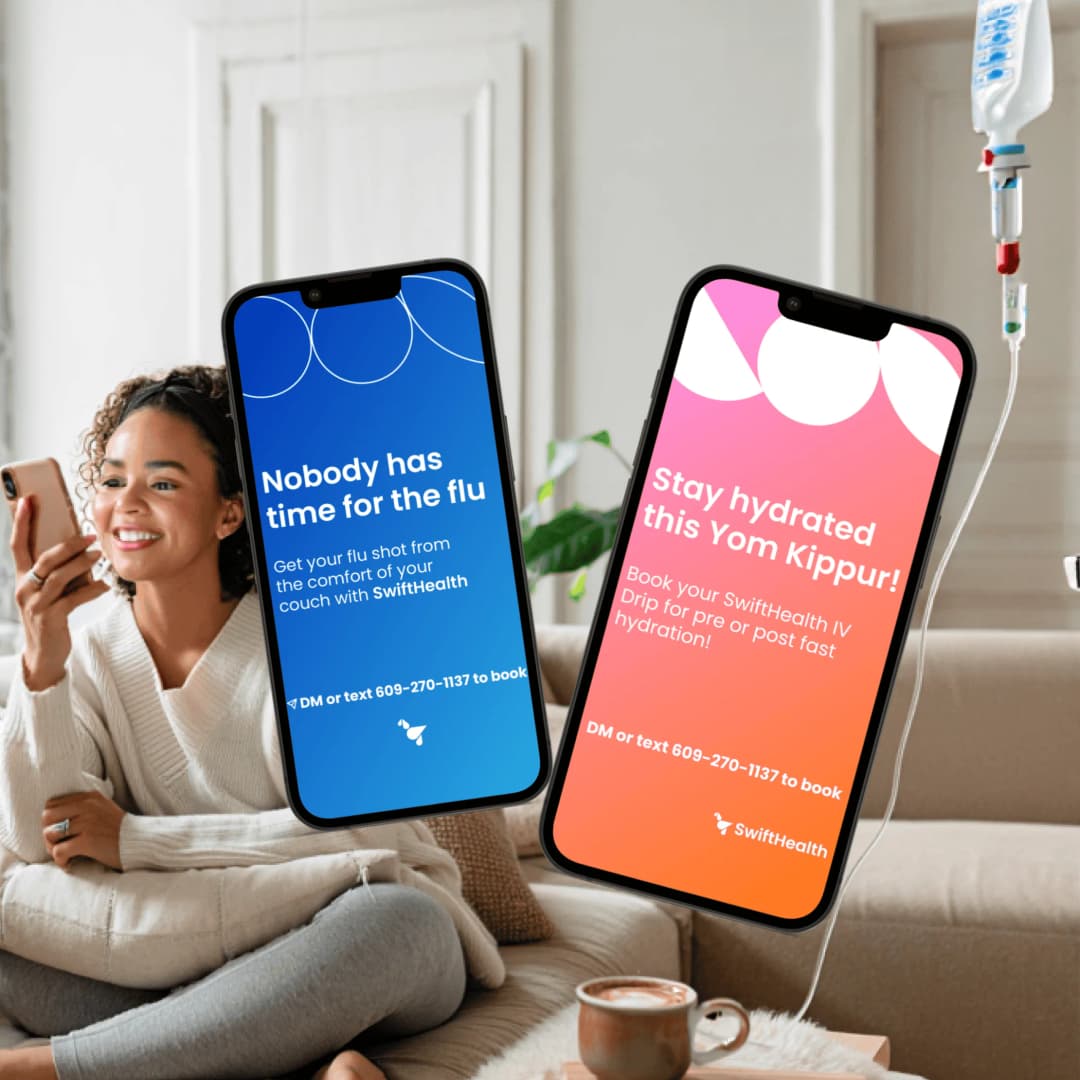
The published scope is identity, messaging, copywriting, and website design. The page says brand messaging, identity, and website structure were connected around a straightforward introduction to the service, with a service menu for options, descriptions, and booking routes. It says the brand and website provide a coherent way to explain the offer and navigate the services. The case study does not report a booking figure, and this article does not add one.
RexMD
RexMD is a men's telehealth platform. The case study says the campaign needed to address erectile dysfunction with confidence and discretion, and to acknowledge the emotional context without making the audience feel reduced to the condition.
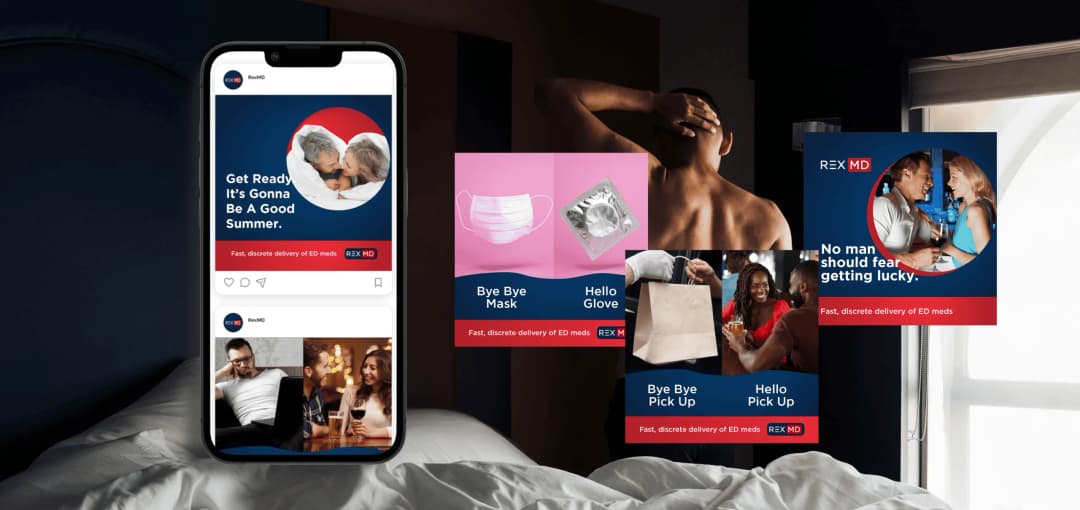
The published scope is campaign strategy, copywriting, and social creative. The page says the work uses distinct directions around privacy, dating, and the decision to seek help, held together by direct copy and a red-and-navy visual system. It says the brand has a range of campaign messages within one creative approach. The case study does not report a conversion figure, and this article does not add one.
HUUG
HUUG is a New York-based intimates brand. The case study says the store needs to help customers navigate styles and pack sizes, and that the same work continues into the messages customers receive before and after a purchase. It says HUUG needed a team that could move between custom Shopify functionality, lifecycle communications, and copy.
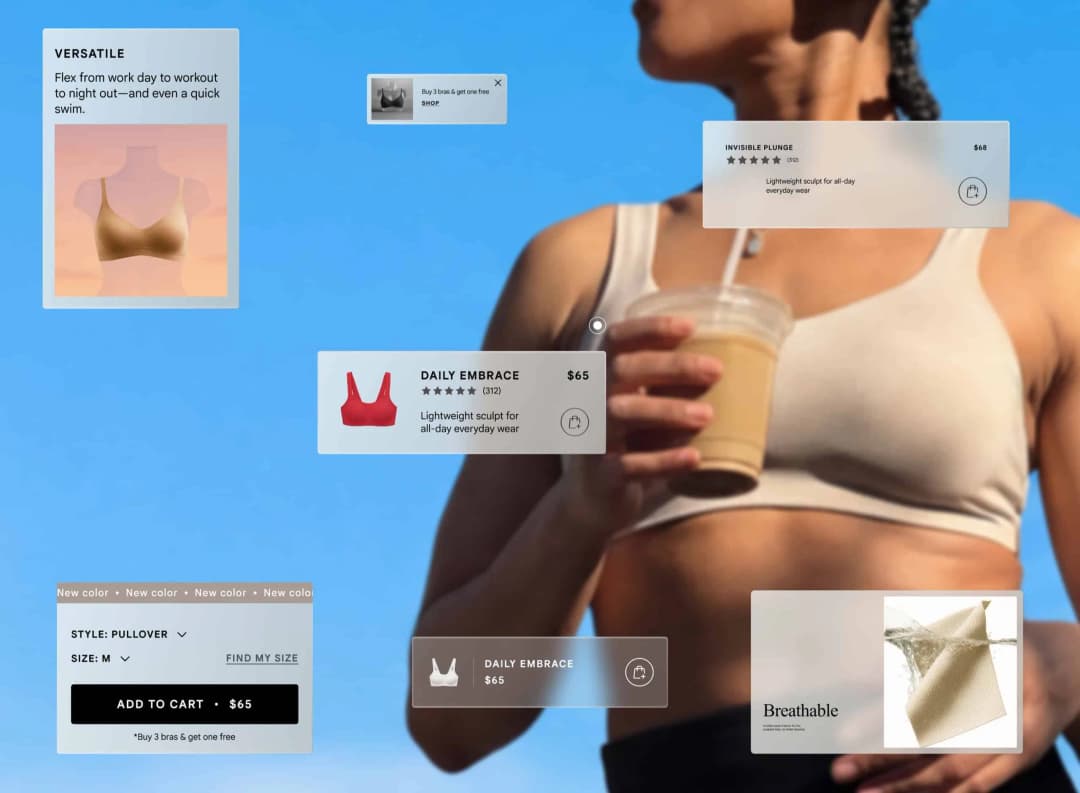
The page says the work included custom style selectors and pack-size logic, a rebuilt set of Klaviyo flows, and copy across the site, products, and email. The case study reports changes in conversion rate, average order value, and first-purchase rate for the periods it names. It says those figures are reported business results rather than a controlled test of Splash's contribution, and that the periods differ in length and season. This article does not restate the percentages. Read them on the case study, with the notes on that page.
What the work costs
Splash Creative is a branding and web design agency at 34 S Dean St, Suite 206, Englewood, NJ 07631. There is no New York City office. David Herskowitz leads the work, with a consistent senior team from the first conversation through the work that follows. The studio serves New York City and Northern New Jersey, and remote clients in the US and worldwide.
Project work is a fixed scope and a fixed fee, agreed in writing before the work starts. These are starting points. The proposal sets the fee for the scope.
| Scope | Starting point | Timing |
|---|---|---|
| Website | from $15,000 | Set in the written proposal |
| Brand identity | from $15,000 | A focused identity takes 4 to 6 weeks. Full brand strategy and identity takes 8 to 12 weeks. |
| Brand and website | from $30,000 | The website schedule is set in the written proposal |
| Shopify store | from about $20,000 | Set in the written proposal |
| Ongoing partnership | from $2,500/month | Set in the written agreement |
Pricing is where those starting points are explained. How we work is the sequence: understand the business, put the scope and the fee in writing, agree the direction, then make the work. How long a brand identity takes walks the identity phases. The website schedule stays in the proposal.
A brand and marketing site uses the website floor, from $15,000, when the identity is already settled. Brand and website together, from $30,000, is the scope when the identity is open and the website is how people will meet the company. If you want to talk through which of those fits, book a call and say what you are working on.
Before you spend on software or on a studio, write down the one job you most need done and whether it repeats on a pattern. Then check whether you can connect that work to a result you already measure.
Frequently asked questions
What is a marketing agent vs. a selling agent?
A marketing agent builds demand and awareness for an offer. A selling agent represents a client in closing a transaction. In real estate, a listing agent represents the seller and a selling agent works with the buyer. Neither role is the same as a marketing agent, who promotes and positions what is being sold.
Is there a standard rule of thumb for marketing plans?
No single numbered rule governs a marketing plan, and labels such as 3-3-3 do not have a standard definition. If someone cites one, ask what it measures and where it comes from, then test it against your own results before it shapes the plan or the budget.
Who are the big 4 AI agents?
No settled list of big 4 marketing AI agents exists. Any list you find is one author's view. Choose an agent by the job, the tools it connects to, and whether a person approves actions before they go live. Start with one narrow task and judge the tool by that result.
What are the 7 main functions of marketing?
Lists of marketing functions vary by source. They generally cover research, positioning, product and pricing input, promotion, distribution, sales support, and measurement. A human agency handles the creative and strategic functions. An AI agent suits the repeatable ones, such as reporting and monitoring.
How do AI marketing agents work?
An AI marketing agent works toward a goal you set, using connected tools and live data. It chooses steps, completes tasks such as drafting copy or flagging ad waste, and reports back. Unlike a fixed automation, it can adjust as conditions change, so a person should approve any action before it goes live.
How much does a marketing agent cost?
It depends on the type. Splash Creative prices project work as a fixed scope and a fixed fee. Brand identity is from $15,000. A website is from $15,000. Brand and website together is from $30,000. A Shopify store is from about $20,000. Ongoing partnerships are from $2,500/month. These are starting points. The proposal sets the fee for the scope. The same figures are on pricing. AI software is priced by the vendor. Metaflow publishes plan prices on its site, including Solo Growth at $99 a month and Scale Pro at $299 a month.
How long does brand identity take?
A focused brand identity takes 4 to 6 weeks. Full brand strategy and identity takes 8 to 12 weeks. The website schedule is the one in the written proposal. It depends on the page list and how fast approvals come back. How long a brand identity takes walks the identity phases.
Have a related question?
Tell us what you're working on. We'll help determine whether there is a useful project to explore.
“Splash delivers powerful brand ID, slick websites and UX, beautiful graphic design, and intelligent software solutions. Great team, great experience, great creative partners.”