Integrated Brand Campaign: How to Plan One That Works
By David Herskowitz, Founder and Creative Director
Learn how to plan an integrated brand campaign that actually works with five essential steps covering strategy, creative, channels, and production.
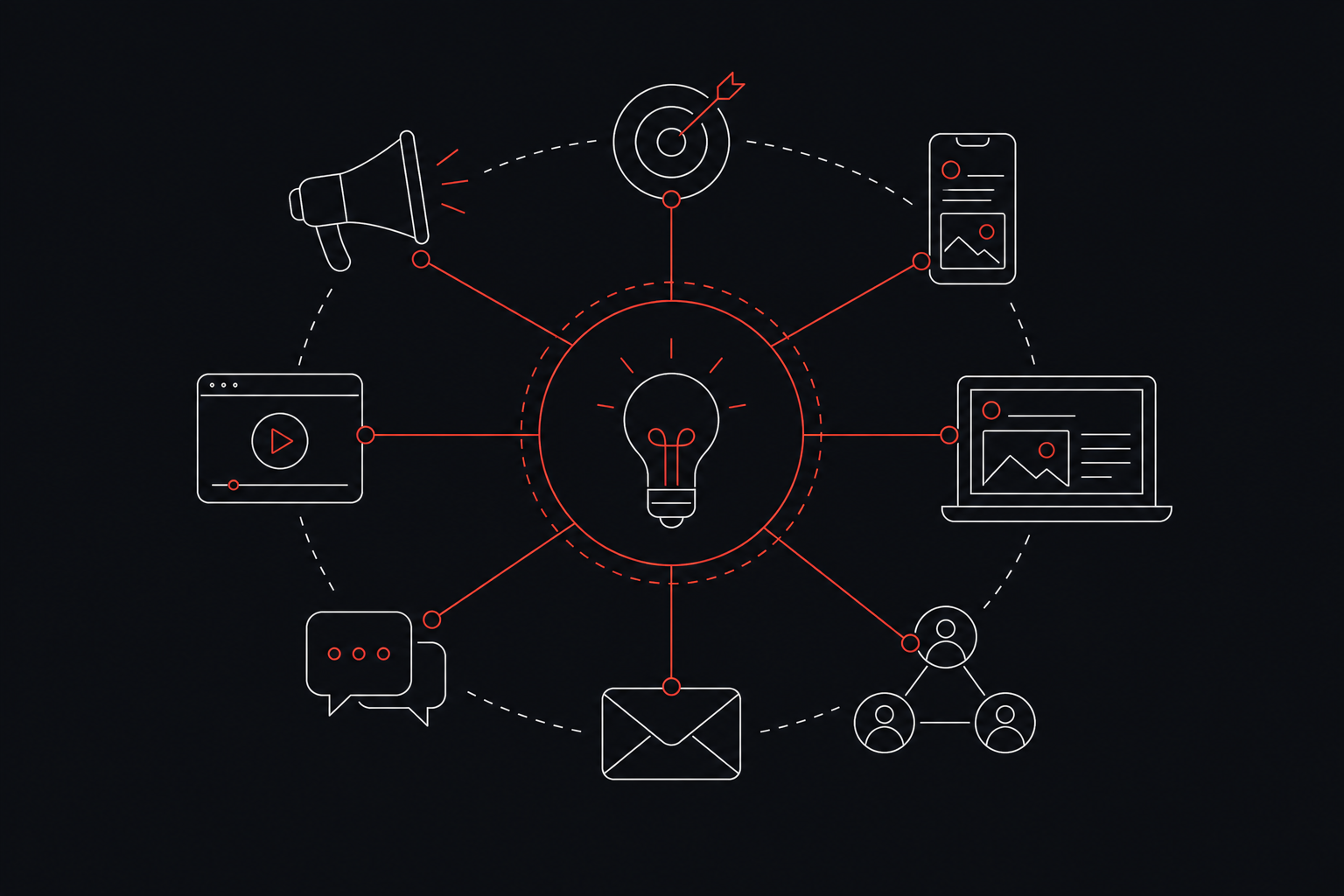
An integrated brand campaign unifies one central idea across every channel, paid, earned, shared, and owned, so each touchpoint reinforces the others instead of repeating the same message. Planning one requires five things: a single job, a clear audience tension, a traveling creative idea, distinct channel roles, and a production system that holds the look together at scale. Most companies still skip at least one of those five, and the campaign falls apart as a result. Each step below includes a check you can use to confirm the plan is sound before production starts.
Integration is not about being everywhere at once. It's about making every channel do a different, coordinated job in service of one idea. The difference sounds subtle. In practice, it determines whether a campaign builds momentum or just adds noise.
What Is an Integrated Brand Campaign?
An integrated brand campaign is a coordinated effort where one central idea travels across every channel your audience touches. Each channel gets a specific job rather than broadcasting the same message in a different format.
That definition separates it from two related terms that get used interchangeably.
Multichannel marketing means you show up on multiple platforms. Email, social, paid search, maybe out-of-home. The channels run in parallel, but they don't necessarily talk to each other. Each one carries its own message, its own creative, and its own logic.
Omnichannel marketing takes that further by connecting the customer's experience across channels, so a cart abandoned on mobile follows the buyer to desktop, or an in-store interaction triggers an email sequence. The focus is continuity of the customer journey.
An integrated brand campaign does something different. It starts with a single idea, then asks: what job should each channel do to advance that idea? Paid media might create awareness. Earned media might add credibility. Owned channels might deepen the relationship. The channels aren't just connected, they're assigned distinct roles within one argument.
This is what integrated marketing communications (IMC) has always described: coordinate every message and every channel so they speak with one voice and build toward one outcome.
Why does the distinction matter? Because multichannel campaigns can still fragment. You can be on six platforms and have six different brand experiences. Research compiled by Superside cites a SuperOffice finding that integrated campaigns are 31% more effective at building brand equity than non-integrated ones, and that 70% of companies still run without a fully integrated strategy. That gap is where most campaign budgets quietly disappear.
People also encounter up to 10,000 ads a day, according to widely reported estimates. Visual and message consistency across channels is what makes any single campaign recognizable in that volume.
Step 1: Give the Campaign One Job
Before you choose a single channel, name the one thing this campaign must accomplish.
Not a list of goals. One job. The specificity is the point.
"Increase brand awareness" is not a job. It's a category. A job sounds like this: "Move first-time visitors from curious to confident enough to request a quote." Or: "Reposition the brand in the minds of buyers who currently see us as a budget option." Those are testable. You can build a campaign around them. You cannot build a campaign around "awareness."
Here's how to get there:
- Name the specific change or decision the campaign must create. What does success look like in the audience's behavior or belief? Write it in one sentence.
- Find the audience tension. Identify the friction between where the audience is right now and where the brand wants to help them get. Are they unaware? Skeptical? Considering a competitor? Stuck in an old perception? The tension is the engine of the campaign idea.
- Test the job against your resources. A campaign job that requires six months of earned media buildup is a different scope than one that can run on paid and owned alone. Name the job before you size the budget, not after.
Most campaign briefs skip step two entirely. They describe the audience demographically, age, income, geography, but not psychographically. They don't name what the audience believes right now that the campaign needs to shift. Without that tension, there's no story. There's only repetition.
The job statement also protects you later. When someone proposes adding a channel, or changing the message mid-flight, the job statement is the filter. Does this serve the one thing we said we were here to do? If not, it doesn't belong in this campaign.
Write the job statement before the brief goes to anyone. It is the brief's foundation.
Step 2: Build a Central Idea That Can Travel
A central campaign idea is not a tagline. It's not a visual treatment. It's the core tension or truth the campaign is built around: specific enough to guide every execution, flexible enough to adapt to every format.
The test is simple: can the idea work as a 30-second video, a social post, an email subject line, and an out-of-home placement without losing its meaning? If it collapses in any of those formats, it's not a campaign idea. It's a single execution pretending to be one.
Coca-Cola's Share a Coke campaign is the clearest modern example of what this looks like at scale. The idea was simple: replace the Coca-Cola logo on bottles with people's names. That one decision traveled to TV, outdoor, social, retail, and PR without changing its meaning. By 2014, Coca-Cola estimated that 94% of the UK population had seen Share a Coke ads at least 20 times, according to Northwestern University Medill IMC Professional's 2026 report. The same campaign drove 1.25 million more teens to try Coke over eight weeks that summer. The idea scaled because it was concrete. Personalization is a concept. Your name on a bottle is an execution of a concept, and it translates to every channel differently without becoming vague.
That's the standard to aim for. Not a concept so broad it could apply to any brand, and not a single execution so specific it only works in one format.
To build an idea that travels:
- Start with the tension from Step 1. The central idea is the answer to that tension, expressed in a way the audience can feel, not just understand.
- State the idea in one sentence without naming a channel. If the sentence requires a channel to make sense, it's an execution, not an idea.
- Test it against your most constrained format first. If the idea works on a billboard, six words, one image, it will work everywhere. If it needs a paragraph to land, it won't survive the campaign.
- Separate the idea from the aesthetic. The visual system (colors, type, motion) is how the idea looks. The idea itself is what it means. Both matter, but they're not the same thing.
Building a visual identity system that supports the campaign idea before production starts is one of the most practical ways to keep assets coherent as the campaign scales.
Step 3: Assign Each Channel a Distinct Role Using the PESO Model
The PESO model gives every channel a job title. PESO is a channel-planning model that groups media into four types: Paid, Earned, Shared, and Owned. When you plan from one brief using all four, each channel advances the campaign idea without duplicating what another channel is already doing.
According to the Chili Publish Brandwidth 2026 report, which surveyed 256 grocery retail marketing leaders, over 80% of campaigns now span both digital and in-store channels. Running across that many surfaces without a role-assignment framework is how campaigns fragment.
Here is what each media type does in an integrated campaign:
Paid media (display, social ads, search, out-of-home) creates reach and controls timing. It puts the campaign idea in front of people who haven't found you yet. Its job is awareness and entry, not conversion, not relationship-building. When paid media tries to do everything, it does nothing well.
Earned media (press coverage, reviews, third-party mentions) adds credibility the brand can't give itself. A journalist writing about your campaign or a customer review referencing your product carries weight that a paid placement never will. Earned media's job is trust. Plan for it from the brief, not as an afterthought once the campaign is live.
Shared media (social content, community, user-generated content) extends the idea through participation. It's where the audience becomes part of the campaign rather than just a recipient of it. Share a Coke worked partly because people photographed their personalized bottles and posted them. Shared media's job is amplification and belonging.
Owned media (your website, email, blog, packaging) deepens the relationship with people who are already paying attention. It's where the campaign argument gets its full length and detail. Owned media's job is conversion and retention.
When you assign roles this way, you stop asking "should we post this on Instagram?" and start asking "what job does Instagram do in this campaign that no other channel does?" That shift prevents duplication and keeps the budget honest.
For the production side of paid and campaign assets, Ad + Campaign Assets covers the creative execution across formats, display, social, and beyond, from a single brief.
Role clarity is what keeps every channel doing its assigned job without duplicating another.
Step 4: Build a Creative System That Holds at Scale
Most campaigns look cohesive in the first week. By week four, when the social team needs new variants, the email team is on a different template, and the out-of-home files are being adapted by a vendor, the campaign starts to look like three different brands.
That's fragmentation. It's a leading production failure point in integrated campaigns, and it's almost always a systems problem, not a talent problem.
The Chili Publish Brandwidth 2026 report found that 57% of campaigns generate between 50 and 200 variants, and 21% produce up to 500 variants per campaign. At that volume, no one can hold visual consistency by memory or good intentions alone. You need a creative system.
A creative system is the set of rules and tools that lets any asset produced at any point in the campaign still look like it belongs. It has four components:
- Templates. Master files for every format the campaign will use, social posts, display ads, email headers, presentation decks. Templates define what can change (copy, image) and what cannot (type size, color use, logo placement).
- Design tokens. The fixed values that define the campaign's visual language: exact hex codes, font weights, spacing units, border radius. Tokens remove ambiguity. "Use the blue" is not a token. "#0033CC" is.
- Motion rules. If the campaign includes video or animated ads, define how things move: entrance speed, easing style, hold duration. Motion is where brand consistency breaks down fastest because it's the hardest to specify in a static style guide.
- Copy patterns. The sentence structures, voice rules, and tone boundaries that keep every headline and caption sounding like the same campaign. Include examples of what's in and what's out.
Build the system before production starts, not after the first round of assets is approved. The longer you wait, the more variants exist without a source of truth, and the harder it becomes to bring them back into alignment.
Keeping branding consistent across digital and print is easier when the system is documented and shared with every team or vendor touching the campaign.
Step 5: Set KPIs and Measure What Integration Actually Does
Integration changes what you should measure, not just how. A campaign where each channel has a distinct job needs channel-level KPIs that match those jobs, plus a campaign-level metric that captures what integration is actually supposed to do.
Start with channel-level KPIs tied to each channel's assigned role from Step 3. Paid media gets reach and frequency metrics. Earned media gets share of voice and mention quality. Shared media gets participation rate and organic amplification. Owned media gets conversion rate and time on page. These are leading indicators. They tell you whether each channel is doing its job.
The campaign-level metric is harder. It measures whether the channels are working together. Brand lift studies, unaided recall surveys, and share-of-search data are the most practical tools here. They capture whether the audience's perception actually shifted, which is the job you named in Step 1.
Attribution is where honest limits matter. Cross-channel attribution data is notoriously difficult. Most models either over-credit the last touchpoint or spread credit so evenly that the data tells you nothing useful. Research compiled by Superside, citing a SuperOffice finding, puts integrated campaigns at 31% more effective for brand equity than non-integrated ones, but that figure comes from a secondary source, and there is no equivalent benchmark specific to B2B contexts. Use it as directional evidence, not a hard target.
What you can measure reliably: whether the campaign moved the specific change you named in Step 1. Did first-time visitors request quotes at a higher rate? Did brand perception shift among your target segment? Those are answerable questions if you set a baseline before the campaign launches.
Set the baseline first. Measure against it. Adjust channel roles mid-campaign if the data shows one channel is underperforming its job. That's what integration makes possible: a system flexible enough to correct itself without losing the central idea.
When to Bring in a Creative Partner for Your Integrated Campaign
Three conditions reliably signal that an external creative partner adds more than it costs: your team is over capacity, no single person owns the central idea end-to-end, or production is fragmenting because too many hands are touching the assets.
Splash Creative is a full-service creative agency that handles brand identity, website design, Shopify and ecommerce builds, email marketing, and AI implementation. Clients work with a single senior team from the first conversation through execution. If your campaign needs someone to hold the idea together across every channel and every asset, that's exactly where an outside partner earns its place.
For context on what brand and creative work costs at this level, the branding cost guide covers typical ranges and what drives them.
FAQs
What does integrated marketing communication mean in practice?
Integrated marketing communication means coordinating every message and every channel so they speak with one voice and build toward one outcome. The planning steps above cover how to do that: one campaign job, a central idea that travels, distinct channel roles, and a creative system that holds everything together.
What is integrated marketing in simple words?
Integrated marketing means every channel your audience touches carries the same core idea, expressed in a way that fits that channel's specific job. It's not about repeating the same ad everywhere. It's about making paid, earned, shared, and owned media work together so each one advances the campaign argument instead of running independently. The result is a campaign that builds on itself rather than starting over at every touchpoint.
What are the most common reasons integrated campaigns fail?
The three most common failure points are: no single owner of the central idea, channel roles that were never assigned so every team defaults to broadcasting the full message, and a creative system that wasn't built before production scaled. Fragmentation during production is the most underestimated risk. By the time it's visible, dozens of off-brand variants already exist and the campaign has lost its coherence.
How many channels should an integrated brand campaign use?
Use as many channels as you can assign a distinct, non-redundant job to, and no more. There is no correct number. A campaign with three channels that each have clear roles will outperform a campaign on eight channels where the message is just repeated in different formats. Start with the job from Step 1, map the audience's path, and add channels only where a gap exists that another channel isn't already filling.
What is the difference between a brand campaign and a product campaign?
A product campaign drives a specific action around a specific offer: buy this, try this, sign up now. A brand campaign shifts perception over time: how the audience thinks and feels about the company, not just whether they convert on a single offer. Integrated brand campaigns are built around the longer arc. They can include product-level calls to action, but the central idea operates above any single product or promotion.
Conclusion
An integrated brand campaign works when every channel has a distinct job, all of them serving one clear idea. That requires five things done in order: a single campaign job, a named audience tension, a central idea that travels, channel roles assigned before production starts, and a creative system that holds everything together as the asset count grows.
If your next campaign is stalling at the brief stage or fragmenting during production, start with the job statement. Write it in one sentence. If you can't, the campaign isn't ready to brief yet. Once the job is clear, the channels, the roles, and the measurement framework follow from it.
Have a related question?
Tell us what you're working on. We'll help determine whether there is a useful project to explore.
“Splash delivers powerful brand ID, slick websites and UX, beautiful graphic design, and intelligent software solutions. Great team, great experience, great creative partners.”