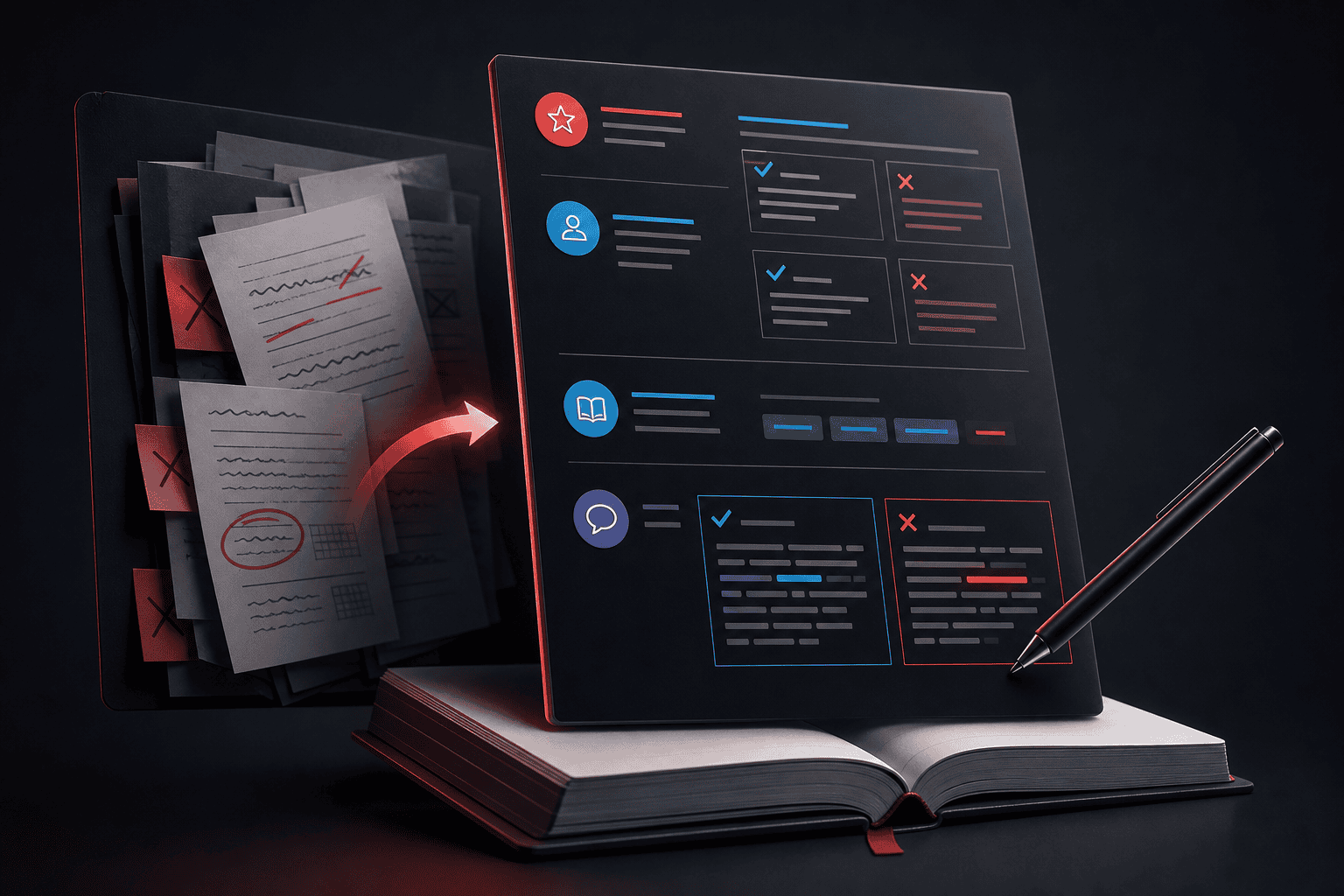
A brand audit checklist covers six areas: goals and scope, visual identity consistency, verbal identity and messaging, digital presence and SEO, customer perception, and competitive benchmarking. Work through each in order, score every finding, and prioritize fixes before briefing a redesign. The whole process can be completed in a week without outside help.
Skipping this step is where redesign budgets go wrong. You brief a designer on the wrong problem, fix the logo while the messaging stays broken, and end up back at the same table in two years. The checklist below gives you a structured way to find what is actually broken before any design work begins.
Why Run a Brand Audit Before You Redesign?
A redesign without an audit is a guess. You might fix the thing that bothers you most visually while leaving the deeper problems untouched. That distinction matters.
Research suggests that brand recognition drives purchasing decisions for 77% of consumers, and businesses that run regular brand audits see revenue growth up to 23% higher than those that skip them. Those figures, reported by Checklistoo in 2025, point to the same conclusion: your brand's consistency and clarity have a direct line to growth.
The consistency problem is widespread. Data from benly.ai shows that 73% of brands carry significant visual identity inconsistencies across channels. A 2024 study of 56 brands found that those with high creative consistency generate 27% more significant brand effects, including awareness and differentiation. System1 research estimates that creative inconsistency will cost brands £3.47 billion in potential growth over the next five years, as reported by Ethical Marketing News. That figure is in British pounds, as reported, but the direction is the same in any currency: inconsistency has a measurable cost, and an audit is how you find where yours is leaking.
What Does a Brand Audit Actually Cover?
A brand audit examines six areas. Each one can surface problems that would otherwise get buried in a redesign brief or missed entirely.
- Goals and scope, What the audit is meant to answer and what decisions it will inform
- Visual identity, Logos, typography, color palettes, and whether they match across every channel
- Verbal identity and messaging, Brand voice, value propositions, and tone consistency across touchpoints
- Digital presence and SEO, Website performance, mobile responsiveness, search visibility, and content gaps
- Customer perception, How your audience actually describes and experiences your brand versus how you intend it
- Competitive benchmarking, How your brand reads against three to five direct competitors on the same criteria
These six areas are not independent. A weak verbal identity often shows up as an SEO problem. A visual inconsistency often traces back to unclear brand guidelines. Working through them in order lets each step inform the next.
How Do You Audit a Brand? A Free Brand Audit Checklist in 6 Steps
Here is the full process, in the order you should run it.
-
Define your audit goals. Before you collect a single asset, write down what you need to know. Are you evaluating whether your brand still fits your market position? Checking whether a product line extension is creating confusion? The goal shapes every other step. A focused audit takes days; an unfocused one takes months and answers less [S1].
-
Collect and review all visual assets. Pull every logo file, font, color specification, and marketing material you can find, across print, digital, social, and packaging. Look for version drift: the logo that got stretched in a slide deck, the off-brand color that crept into email templates, the outdated tagline still running on a vendor's co-branded piece. Document every inconsistency you find [S2]. Data shows 73% of brands carry these gaps, so expect to find more than you think.
-
Audit your messaging. Read your homepage, your social bios, your email footers, and your sales deck back to back. Ask whether they sound like the same company. Check that your core value proposition appears in the same form across all channels and that your brand voice is consistent in tone and register. Note anywhere the language contradicts itself or drifts into generic territory [S3].
-
Review your digital touchpoints. Run your site through a speed test. Check mobile responsiveness on at least two device sizes. Pull your top-ten organic search terms and compare them to the pages you actually want ranking. Look at your Google Business profile, your social handles, and any third-party listings for accuracy and consistency [S4]. Your digital presence is where consistency is most visible to new audiences, so gaps here tend to have an outsized effect on first impressions.
-
Measure customer perception. Send a short survey to recent customers or run a social listening pass across your brand name and product terms. You are looking for the gap between how you describe yourself and how your audience describes you. That gap is where the real brief for a redesign usually lives [S5].
-
Benchmark against competitors. Choose three to five direct competitors and evaluate them against the same criteria you used for your own brand: visual clarity, messaging consistency, digital performance, and perceived positioning. You are not looking for what to copy. You are looking for where the category has converged and where there is space to differentiate [S6].
For a deeper look at what each of these steps uncovers in practice, see what we look for when we audit a brand.
How Do You Score and Prioritize Your Audit Findings?
Score each finding on two dimensions: impact and effort. That combination tells you where to start.
Use a simple 1-3 scale for each dimension. Impact measures how much fixing this issue would improve brand clarity, consistency, or commercial performance. Effort measures how much time, money, or coordination the fix requires. Divide impact by effort to get a relative priority: higher means act sooner.
| Finding | Impact (1-3) | Effort (1-3) | Priority | Action |
|---|---|---|---|---|
| Logo used in 3 different versions | 3 | 1 | High | Fix first |
| Homepage headline misaligned with positioning | 3 | 2 | Medium-high | Fix next |
| Brand color off-spec in email templates | 2 | 1 | Medium | Fix next |
| Full brand guidelines document missing | 3 | 3 | Low | Plan for redesign |
| Social bios inconsistent across platforms | 1 | 1 | Low | Fix when convenient |
High impact, low effort items go first. High impact, high effort items belong in the redesign brief. Low impact items get addressed last or not at all.
This scoring step is what most free brand audit checklists skip. Without it, you end up with a list of problems and no clear order of operations. Fixing the highest-impact gaps first is what actually moves consistency forward.
Is Your Brand Showing Up in AI Search Results?
AI-powered search tools now answer brand queries directly, often without sending users to your website. How your brand is described in those answers matters as much as how it ranks in traditional search.
Search your company name and your core service category in ChatGPT, Perplexity, and Google's AI Overview. Note whether the description matches your current positioning and flag outdated information or gaps where a competitor is named and you are not. The fix usually starts with cleaner, more consistent content on your own site.
When Should You Bring In a Branding Agency?
DIY audits work well when the problems are operational: inconsistent files, outdated copy, off-spec colors. You can find and fix those without outside help.
Bring in an agency when the audit reveals a strategic problem. If your positioning is unclear, your messaging contradicts itself across channels, or your visual identity no longer reflects where the business is going, those are not file management issues. They require strategic thinking before any design work starts. The agency vs. in-house design guide lays out the real trade-offs, including cost, control, and speed.
What Does It Cost to Fix the Issues Your Audit Uncovers?
The cost depends on what the audit surfaces. A few inconsistent files and an outdated bio are internal fixes. A full rebrand with new positioning, visual identity, and a website is a different conversation.
Splash Creative is a full-service branding and design agency that handles strategy, visual identity, web design, graphic design, and email marketing under one roof. Plans start at $999 per month for foundational work and scale to $2,500, $5,000, and $10,000 per month depending on scope and output volume. Fixed-fee scoping means you know what you are getting before any work begins, which makes it easier to match the investment to what your audit actually found.
For a fuller breakdown of what different investment levels cover, the branding cost guide for 2026 walks through agency pricing in detail. And if your audit reveals enough to warrant a full rebrand versus a lighter refresh, the rebrand vs. refresh decision framework can help you decide which path fits your situation.
FAQs
What areas does a brand audit typically cover?
A brand audit typically examines goals and scope, visual identity, verbal identity and messaging, digital presence and SEO, customer perception, and competitive benchmarking. The six-step checklist in this article addresses each of those areas in sequence.
How often should a brand audit be performed?
Most businesses benefit from a full brand audit every one to two years. Run one before any major redesign, before entering a new market, after a significant product or business model change, or when customer feedback suggests a gap between your brand's intent and how it is actually perceived.
Can a small business run a brand audit without a consultant?
Yes. The six-step checklist above is designed to be completed internally. You need access to your own assets, a few hours of focused time, and a willingness to look at your brand from the outside. The scoring table in this article gives you a way to prioritize what you find without needing outside expertise to interpret the results.
What tools can help with a brand audit?
Most of the audit work uses tools you likely already have: Google Search Console for SEO data, PageSpeed Insights for site performance, and a spreadsheet for tracking findings. For organizations that want structured brand research support, specialist brand strategy firms offer audit services, though these are typically scoped for medium to large organizations and priced accordingly.
How long does a brand audit take?
A focused audit using the six-step checklist can be completed in three to five business days. Step one (goal setting) and step two (asset collection) usually take the longest if your files are scattered. The scoring and prioritization step at the end typically takes two to three hours once all findings are documented.
Conclusion
A brand audit checklist gives you a clear picture of what is working, what is inconsistent, and what needs to be fixed before any design work starts. Work through the six steps in order, score each finding by impact and effort, and you will have a prioritized brief rather than a vague request for "something fresher."
Start with the asset collection step. Pull every logo, color file, and piece of copy you can find and lay them side by side. What you see in that first pass usually tells you more about your brand's real state than any strategy document will.