- What an Unlimited Design Service Actually Includes
- What the Word "Unlimited" Actually Means
- What an Unlimited Design Service Doesn't Do
- When an Unlimited Design Service Makes Sense
- The Piecemeal Problem
- How to Decide Which Model Is Right for You
- FAQs
If you've been shopping for creative help and landed on an unlimited design service, the pitch is hard to ignore. One flat monthly fee, submit as many requests as you want, get designs back in a day or two. It sounds like the answer to every founder's creative bottleneck.
But "unlimited" is doing a lot of work in that sentence. Before you hand over a subscription fee, it's worth understanding exactly what these services deliver, where they fall short, and whether any of that matches what your business actually needs right now.
What an Unlimited Design Service Actually Includes
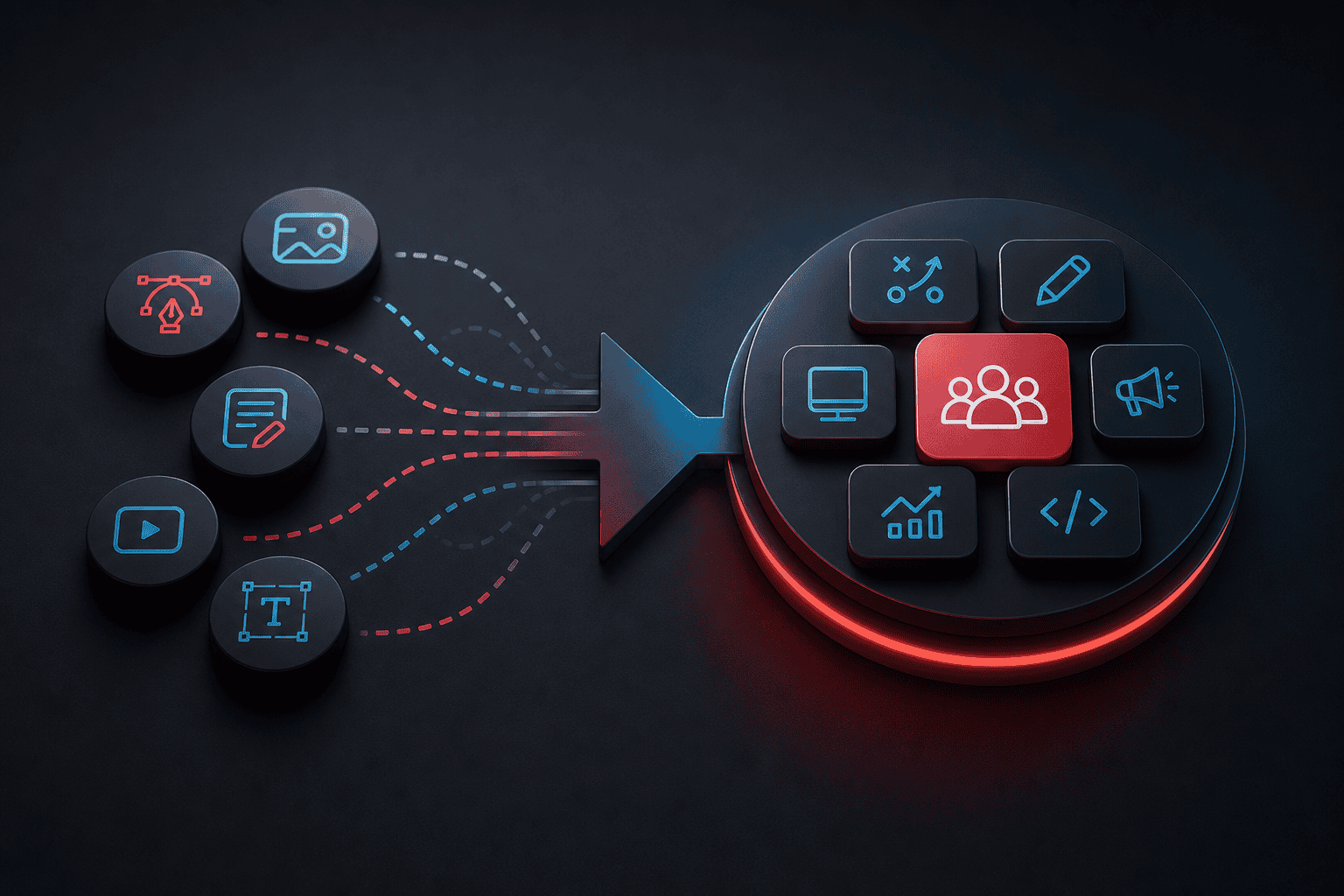
The core model is simple. You pay a monthly fee, join a queue, and a designer works through your requests one or two at a time. Most services in this category — including ManyPixels, Penji, and Awesomic — operate this way.
What you typically get:
- Social media graphics — posts, story templates, banner ads
- Marketing collateral — flyers, brochures, presentation slides
- Basic brand assets — simple logo variations, icon sets, brand-adjacent graphics
- Ad creatives — static display ads, email headers, digital campaign assets
For a business that already has a brand and just needs a steady stream of production-level graphics, this model works reasonably well. Consistent output, predictable cost, no full-time hire required.
The subscription format also removes the friction of scoping individual projects. Need ten social posts this week and a trade show banner next week? Submit the requests and let the queue handle it.
What the Word “Unlimited” Actually Means
Here's where the fine print matters. "Unlimited requests" doesn't mean unlimited simultaneous work. Most services process one or two active requests at a time. If you have a product launch coming up and need fifteen assets ready by Friday, you're working against the queue, not with it.
Turnaround times are also tied to complexity. A simple social graphic might come back in 24 to 48 hours. A more detailed asset — especially one requiring multiple revision rounds — can stretch across several days. When you're running a campaign with a hard deadline, that pace creates real pressure.
Revisions are included, but they're iterative. If the designer misunderstands the brief, you go back into the queue for the next pass. There's no live conversation, no kickoff call where someone asks what you're actually trying to accomplish. You write a brief, they execute it, you review it, and the cycle continues.
That's fine for execution. It's not fine for strategy.
What an Unlimited Design Service Doesn’t Do
This is the part that catches founders off guard — especially those who come to a subscription service expecting a creative partner rather than a production tool.
No Brand Strategy
Unlimited design services are built to execute briefs, not write them. If you don't already know what your brand stands for, who it's speaking to, and how it should look and feel, a subscription service can't figure that out for you. You'll get designs back, but they'll be executions of whatever you described in the request form — not a coherent brand system built on a strategic foundation.
ManyPixels, for example, explicitly does not offer discovery or strategic consultancy. Penji has been described in independent reviews (Buzzcube, 2026) as a "steady design utility" that struggles when clients expect brand strategy, web development, or scalable e-commerce execution. These are production services, and that's exactly what they're built to be.
No Web Design or Development
If you need a website, a Shopify store, or a landing page built, subscription design services are the wrong tool. They produce static design files. They don't write code, configure platforms, build e-commerce flows, or set up product pages. A designer can mock up what a page might look like — but they can't build it.
That's a meaningful gap for DTC founders and e-commerce operators. Getting a brand refresh through a subscription service and then hiring a separate Shopify agency to build the store means two separate briefs, two separate relationships, and no guarantee the output will feel like the same brand.
No Email Marketing or Klaviyo Integration
Email is where a lot of DTC revenue actually lives, and subscription design services don't touch it. They might design an email template if you ask, but they won't set up your Klaviyo account, build your automation flows, write your sequences, or track what's performing. That work sits entirely outside the subscription model.
No Defined Endpoint or Deliverable Set
A subscription service has no natural finish line. You pay month to month, submit requests as they come up, and the engagement continues indefinitely. For some businesses, that's exactly right. For a founder who needs a complete brand identity, a working website, and a functioning email program by a specific date, the open-ended structure is a liability, not a feature.
There's also no scope document. Nothing gets agreed in writing before the work starts. If your needs shift or the output doesn't match expectations, you have limited recourse beyond continuing to submit revision requests.
When an Unlimited Design Service Makes Sense
To be fair, there are genuine use cases where this model fits.
If you have an established brand with clear guidelines and you need a reliable stream of on-brand production assets, a subscription service can handle that well. Marketing teams at companies that already know what they look like, already have a website, and just need someone to execute social posts and ad creatives are a natural fit.
The model also works for businesses with low-complexity, high-volume design needs — where the queue pace isn't a bottleneck and the work doesn't require strategic input.
What it doesn't work for: a founder who needs to build or rebuild a brand from scratch, launch a Shopify store, set up email automation, and have everything working together before a product launch or fundraise.
The Piecemeal Problem
Here's what often happens in practice. A founder signs up for an unlimited design service to handle the brand. Then they hire a separate Shopify agency for the website. Then they bring in a Klaviyo specialist for email. Each vendor does their part, but nobody owns the whole picture.
The brand guidelines the design service produced don't quite translate to the Shopify theme the web agency chose. The email templates the Klaviyo specialist builds don't match either. The founder ends up as the project manager connecting three separate vendors who never talk to each other.
That's the piecemeal problem, and it's a real cost — measured in time, coordination overhead, and a brand that looks slightly different everywhere it shows up.
The alternative is a studio that handles strategy, identity, web, and email as a single scoped engagement. Splash Creative works this way: brand strategy through Klaviyo campaigns, no handoffs between vendors, every project scoped in writing and priced as a fixed fee before kickoff. For founders who need the whole thing built — not just a graphics queue filled — that structure removes a significant amount of friction.
How to Decide Which Model Is Right for You
Three questions worth asking before you commit to either model.
Do you already have a brand? If you have a visual identity you're happy with, clear brand guidelines, and you just need production support, a subscription service might be all you need. If you're building or rebuilding the brand, you need strategy first — and subscription services don't provide it.
Do you need a website or Shopify store built? If yes, a subscription service can't help with that. You'll need either a full-service studio or a separate web agency, which brings you right back to the piecemeal problem.
Do you have a deadline? Subscription services work on queues. If you have a hard launch date, a fundraise presentation, or a product going live in eight weeks, you need a scoped project with a defined timeline — not an open-ended queue.
If your answers point toward a production utility, a subscription service is a reasonable option at a predictable monthly cost. If your answers point toward building something from the ground up, the subscription model will likely leave you frustrated and still searching for the strategic layer it never offered.
FAQs
What does an unlimited design service actually include?
Most unlimited design services cover social media graphics, marketing collateral, presentation slides, ad creatives, and basic brand assets. They process requests one or two at a time through a queue — not all at once, despite the "unlimited" framing.
Can an unlimited design service build my website?
No. Subscription design services produce static design files. They don't write code, build Shopify stores, configure platforms, or develop functional websites. For web development, you need either a full-service studio or a dedicated web agency.
Do unlimited design services include brand strategy?
No. These services are built to execute briefs you provide, not develop the strategy behind them. If you need to define your brand positioning, visual direction, or messaging framework, you need a studio that offers strategy as part of the engagement.
What is the difference between a design subscription and a fixed-fee branding project?
A design subscription is an ongoing monthly service with no defined endpoint or deliverable set. A fixed-fee branding project is scoped in writing before work begins, has a clear set of deliverables, and ends when those deliverables are complete. That structural difference matters most when you have a specific outcome in mind rather than an ongoing production need.
Can I use an unlimited design service for Klaviyo email marketing?
No. Subscription design services may produce email template graphics if you request them, but they don't set up Klaviyo accounts, build automation flows, write email copy, or track campaign performance. Email marketing strategy and implementation sits entirely outside the subscription model.
When does an unlimited design service make sense?
It makes sense when you already have a complete, established brand identity and just need a reliable stream of production assets — social posts, ad creatives, and collateral — without requiring strategy, web development, or email marketing support.
What should I look for if a subscription service isn't the right fit?
Look for a studio that handles strategy and execution under one roof, scopes projects in writing before kickoff, and covers brand identity, web development, and email marketing without requiring you to manage multiple vendors. That single-vendor structure removes the coordination overhead that comes with stitching together separate specialists.