- What a Creative Agency Retainer Model Actually Means
- What Project-Based Engagements Look Like
- The Core Decision: What Are You Actually Trying to Build?
- Where Retainers Go Wrong
- Where Project Work Goes Wrong
- A Practical Framework for Making the Decision
- How Full-Service Studios Handle Both Models
- What to Ask Before You Sign
- FAQs
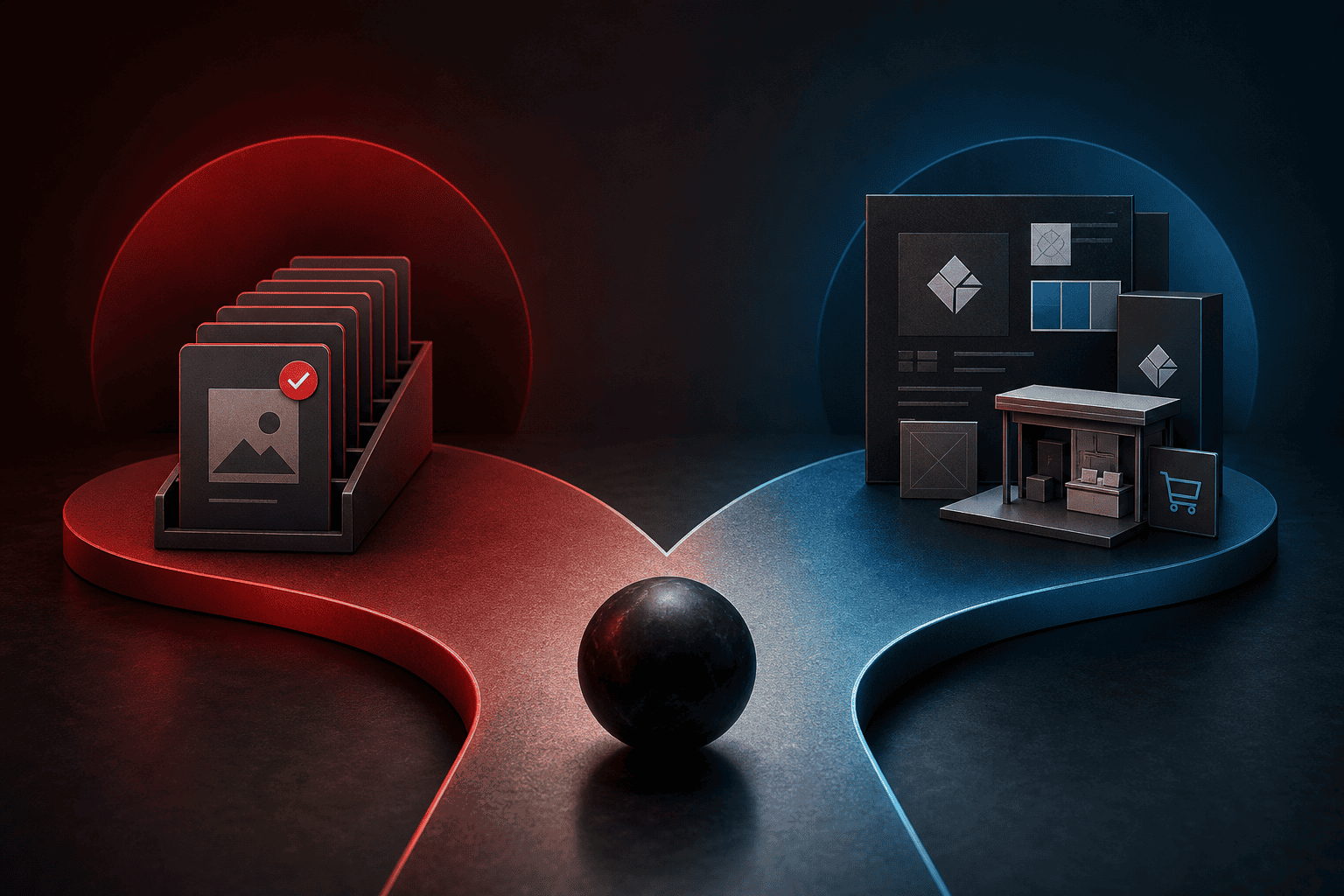
The retainer-vs.-project question comes up early in almost every founder's search for design help. It sounds like a billing preference. It's actually a strategic decision that shapes how much you spend, what you get, and whether the relationship compounds over time or ends at delivery.
Getting it wrong is expensive in both directions. Lock into a retainer when you only needed a brand identity and a website, and you're paying monthly fees for work you can't quite define. Go project-only when you actually need ongoing creative support, and you'll spend the next year stitching together one-off engagements with no continuity between them.
Here's how each model works, where each one fits, and what you should nail down before you sign anything.
What a Creative Agency Retainer Model Actually Means
A retainer is a recurring engagement where you pay a set amount each month in exchange for a defined scope of ongoing work. In theory, it gives you consistent access to a creative team without re-briefing, re-negotiating, and re-onboarding every time a new need surfaces.
In practice, retainers vary enormously. Some agencies use them to cover ongoing campaign work — monthly email design, social graphics, ad creative, performance reporting. Others use the term loosely to mean "we're available when you need us," which can leave you paying for capacity you're not using.
A well-structured creative agency retainer should specify:
- What deliverables are included each month (or what hours are allocated)
- What falls outside the retainer and how overages are handled
- Whether unused capacity rolls over — or doesn't
- Notice periods and exit terms
If an agency can't answer those questions clearly before you sign, the retainer will become a source of friction rather than creative output.
When Retainers Make Sense
Retainers work best when your creative needs are genuinely recurring and volume-dependent. If you're running a DTC brand that sends new email campaigns every two weeks, refreshes social content monthly, and needs landing page updates tied to promotions, a retainer gives you a reliable production pipeline without the overhead of scoping each piece individually.
They also make sense when strategic continuity matters. An agency embedded in your brand for six months understands your voice, your customer, and what's worked before. That institutional knowledge has real value, and a retainer preserves it.
Where retainers fall short is when your creative needs are front-loaded. If you need a brand identity, a website, and a Klaviyo setup, those are finite deliverables with a clear end state. Paying a monthly fee indefinitely for work that should have a defined finish line is a structural mismatch.
What Project-Based Engagements Look Like
A project engagement is scoped, priced, and delivered against a defined set of deliverables. You agree on what gets built, what it costs, and when it's done. When the project closes, the engagement ends unless you choose to start another one.
The clearest advantage is predictability. You know what you're getting, what you're paying, and when it's finished. There's no ambiguity about what the monthly fee covers, because there is no monthly fee — just a project price, a scope document, and a delivery timeline.
For growth-stage founders, this model tends to fit better at the start of a creative relationship. You're investing in building the brand and the site, not maintaining an ongoing production calendar. Once those foundations are in place, you can evaluate whether ongoing support makes sense.
The Fixed-Fee Variant
One version of project work worth understanding specifically: the fixed-fee engagement, where the project price is agreed in writing before kickoff and doesn't change based on hours logged. This removes the anxiety that comes with hourly billing, where every revision or additional meeting adds to the invoice.
Fixed-fee project work puts the scope risk on the agency, not the client. If the agency underestimates the effort, that's their problem to solve. If you add meaningful new scope mid-project, that triggers a change order — a normal and fair process. But within the agreed scope, the price holds.
Splash Creative structures every engagement this way: fixed-fee, scoped in writing before kickoff, no hourly billing. For founders who've been burned by open-ended freelancer invoices or retainers where the deliverables felt vague, that structure changes the dynamic considerably.
The Core Decision: What Are You Actually Trying to Build?
The right model depends less on which one sounds better in theory and more on what you're trying to accomplish right now.
Is the work front-loaded or ongoing?
Brand identity, web design, and a Shopify build are front-loaded. You need them built once, well. A retainer adds no value there because there's no ongoing production volume to justify the recurring fee.
Email marketing is different. If you're sending campaigns every two weeks and building out automation flows over time, the work genuinely recurs. An ongoing engagement makes more sense because the output is continuous.
Do you have a defined brief or an evolving one?
If you know what you need, a project engagement lets you price it, scope it, and get it done. If your needs are still forming, a retainer offers flexibility — but that flexibility comes at a cost. Vague briefs on retainers tend to produce vague work.
The better answer to an evolving brief is usually to narrow it down before engaging anyone. Define the first project clearly, execute it, then assess what comes next. Chaining well-defined projects is often more effective than a retainer that covers everything loosely.
How important is creative continuity?
If you're producing a high volume of content across multiple channels, continuity matters. The agency that built your brand guidelines should ideally be the one applying them to every touchpoint. A retainer preserves that in a way one-off projects don't.
If you're earlier in the process, continuity is less about ongoing production and more about having a single studio handle strategy through execution. That's achievable through a well-scoped project rather than a retainer.
Where Retainers Go Wrong
The most common failure mode is scope drift. Month one has clear deliverables. By month four, the agency is doing a bit of everything and neither side can articulate what the retainer actually covers. The client feels like they're not getting value. The agency feels like they're doing more than they're paid for. Both are probably right.
The second failure mode is dependency without accountability. Retainers can create situations where the client becomes reliant on the agency for work they could have built internal capacity for — and the agency has little incentive to help them do so. A good agency should be transparent about when a retainer is the right structure and when it isn't.
The third is mismatched expectations around availability. Some clients interpret a retainer as "the agency is always available to me." Most agencies interpret it as "we deliver the agreed scope each month." When those expectations diverge, the relationship deteriorates.
Where Project Work Goes Wrong
Project engagements have their own failure modes. The most common is scope creep — the client keeps adding to the brief, and the agency either absorbs the cost and resents it, or issues change orders that feel adversarial.
The fix is a detailed scope document before kickoff. Not a paragraph summary — a specific list of deliverables, revision rounds, and what's explicitly excluded. A studio that won't produce that document before asking you to sign is one worth thinking carefully about.
The second failure mode is a poor handoff. The project ends, the files are delivered, and the client realizes they don't know how to apply the brand system, update the site, or maintain the Klaviyo flows. Good project engagements include documentation, training, or defined post-launch support so the work doesn't become a black box.
A Practical Framework for Making the Decision
Before you engage any creative agency, work through these four questions.
1. What are the specific deliverables you need in the next 90 days?
List them. If the list is finite and has an end state, a project engagement fits. If it's genuinely open-ended and recurring, a retainer might.
2. What's your budget structure?
Can you allocate a defined project budget, or do you need to spread spending over time? Project work often requires a larger upfront commitment. Retainers spread cost but also spread the timeline for seeing results.
3. How much internal creative capacity do you have?
If you have no one in-house managing creative, a retainer gives you consistent access to a team. If you have a designer or marketing manager internally, you may only need a studio for specific projects where deeper expertise is required.
4. What does success look like at the end of the engagement?
If success is a finished brand identity and a live website, that's a project. If success is a measurable improvement in email revenue over six months, that's ongoing work — and a retainer or defined ongoing engagement makes more sense.
How Full-Service Studios Handle Both Models
Some studios specialize in one model. Full-service studios that handle strategy through execution tend to structure foundational work — brand identity, web design, Shopify builds — as projects, then shift to ongoing support for production-heavy work like email marketing and campaign assets.
The advantage of working with a studio that can do both is that you don't have to re-brief a new agency when your needs evolve. The team that built your brand knows how to apply it. The team that built your Shopify store knows how to optimize it. That continuity is hard to replicate when you're managing multiple vendors.
For DTC and e-commerce brands especially, the combination of a strong brand identity, a Shopify store, and an active Klaviyo email program represents the core creative infrastructure. Building those three things with one studio, in a defined sequence, tends to produce more coherent results than assembling them from separate vendors over time.
What to Ask Before You Sign
Whether you're evaluating a retainer or a project engagement, these questions separate studios that can deliver from ones that will frustrate you.
- Is the scope documented in writing before kickoff, or are we agreeing to a general description?
- How are revisions handled, and how many rounds are included?
- What happens if the project runs over the agreed timeline?
- Who owns the files and assets at the end of the engagement?
- What does post-launch support look like, and is it included or billed separately?
- If this is a retainer, what specifically is delivered each month, and what triggers a change order?
A studio that can answer these questions clearly — before you've committed to anything — has done this enough times to know where the friction points are.
FAQs
What is a creative agency retainer model?
A creative agency retainer is a recurring engagement where a client pays a set monthly fee in exchange for a defined scope of ongoing creative work — email campaigns, social graphics, ad creative, and so on. The scope should be clearly defined in writing, not left open-ended.
Is a retainer or project engagement better for a startup?
Most early-stage and growth-stage startups are better served by project engagements for foundational work like brand identity and web design. Retainers make more sense once the brand is built and you have recurring production needs — monthly email campaigns, ongoing ad creative, and similar work.
What does fixed-fee project work mean?
Fixed-fee means the project price is agreed in writing before work begins and doesn't change based on hours logged. Within the agreed scope, the price holds. Changes to scope trigger a formal change order rather than an open-ended invoice.
How do I know if my creative needs are ongoing or project-based?
Ask whether the work has a defined end state. Brand identity, a website, and a Shopify build all have finish lines. Email campaigns, social content, and ongoing optimization don't. If your needs are a mix of both, start with a project for the foundational work and evaluate ongoing support once that foundation is in place.
What are the biggest risks with creative retainers?
Scope drift is the most common — deliverables become vague over time and neither side is clear on what the retainer covers. The fix is a detailed monthly scope document that specifies deliverables, revision rounds, and what falls outside the agreement.
Can a full-service studio handle both project work and ongoing support?
Yes, and for most brands this is the most practical structure. A studio handles the foundational work first — brand identity, web design, Shopify build — then transitions into ongoing support for production-heavy work. The advantage is continuity: the same team that built the brand applies it going forward.
What should a scope document include for a project engagement?
A solid scope document should list specific deliverables, the number of revision rounds included, what's explicitly excluded, the timeline, payment terms, and what happens if scope changes. If a studio won't produce this before kickoff, that's a meaningful signal about how the project will be managed.
The choice between a retainer and project work isn't about which model is inherently better. It's about matching the structure of the engagement to the nature of the work. Define what you need, ask the right questions before you sign, and make sure the scope is in writing regardless of which model you choose.
If you're working through what kind of engagement makes sense for your brand right now, Splash Creative scopes every project in writing before kickoff — fixed-fee, no hourly billing, no retainer ambiguity on project work. Let's talk about your project.