- What a Design Subscription Service Actually Gives You
- What a Full-Service Agency Gives You
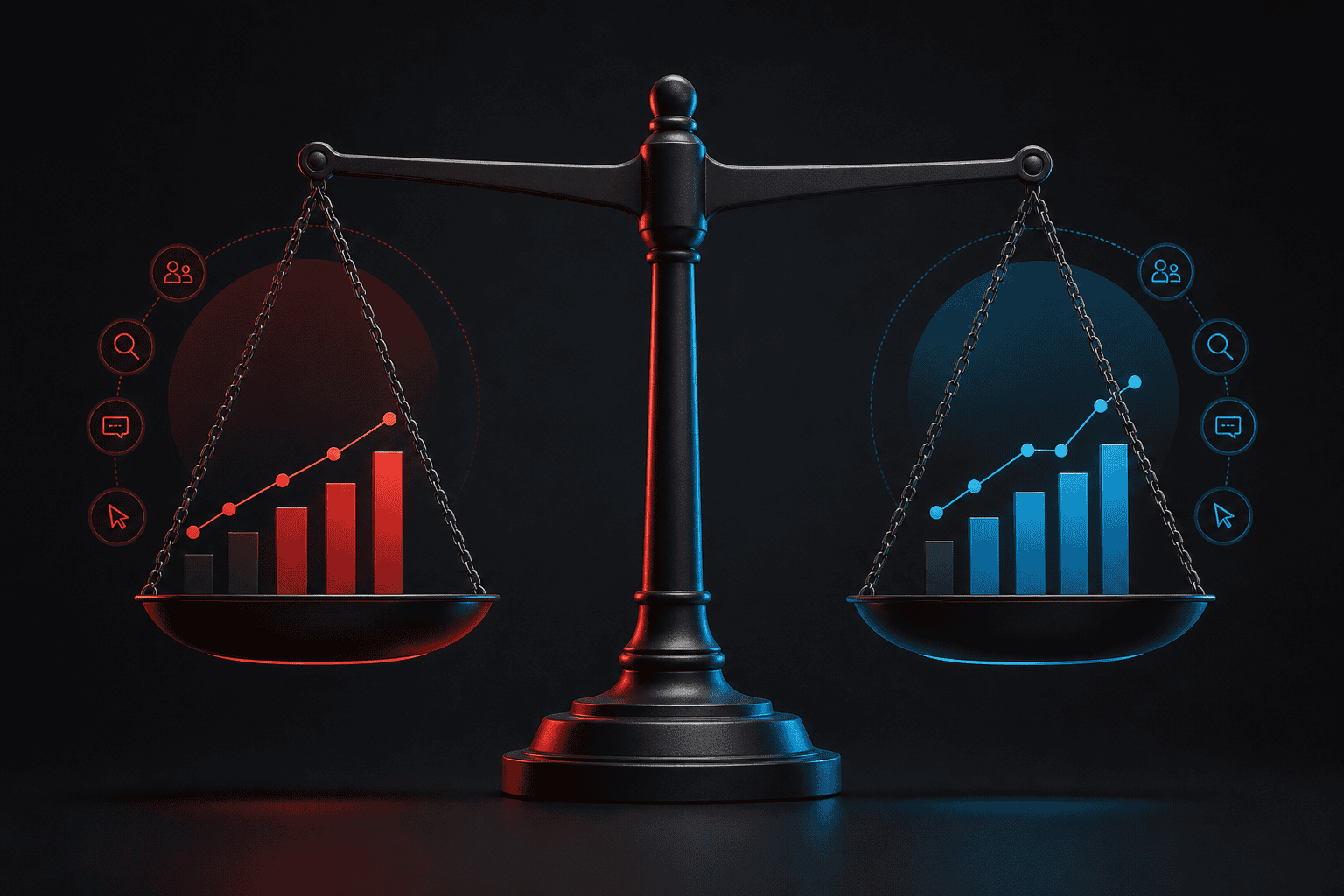
- Comparing the Two Models Side by Side
- Which Stage of Business Are You In?
- The AI Factor in 2026
- When a Fixed-Fee Scope Is the Right Answer
- Frequently Asked Questions
Weighing a design subscription service against a full-service agency comes down to one question: what does your brand actually need right now? Production volume and a low monthly bill look attractive until you realize the work arriving in your inbox has no strategic thread connecting it. Here's an honest breakdown of both models so you can match the right one to where your business actually is.
What a Design Subscription Service Actually Gives You
The premise is simple: pay a flat monthly fee, submit requests through a queue, and a designer works through them one at a time. Services like ManyPixels, Penji, and Awesomic operate this way. Social graphics, ad creatives, pitch deck slides, production assets — you get a steady stream of output without hiring a full-time designer.
The appeal is real. According to TDS DaaS, adoption of formal design subscriptions among businesses with at least 20 employees in English-speaking markets rose to 14% in early 2026, and the global Design as a Service market reached $12.4 billion in 2025. These services filled a genuine gap for teams that need consistent production work but can't justify a full-time hire.
The limitations are just as real. Subscription services run on ongoing monthly billing with no defined project endpoint and no scoped deliverables. There's no brand strategy layer, no Shopify development, no Klaviyo integration. You're buying production capacity, not strategic thinking. And the "unlimited requests" model sounds generous until you discover that throughput is one active task at a time — complex deliverables take longer than simple ones, and the queue is the real constraint, not the price.
The Cost Math Worth Doing
Atico³ published an analysis noting that a full year of a design subscription at €3,750 per month costs €45,000, compared to a minimum of €65,000 for an in-house senior designer. On that comparison, subscriptions win. But for most growth-stage founders, that's not the right comparison. The question isn't subscription versus in-house hire. It's subscription versus a scoped agency project that actually moves the needle.
A year of subscription spend on production assets that lack strategic coherence is money spent on execution without direction. If your brand positioning is unclear, your visual system is inconsistent, or your website isn't converting, more social graphics won't fix any of that.
What a Full-Service Agency Gives You
An agency engagement is a different kind of investment entirely. You're not buying a queue. You're buying a defined scope of work with a clear start, a clear end, and a team that's accountable for the outcome.
At Splash Creative, every project is fixed-fee and scoped in writing before kickoff. You know exactly what you're getting, what it costs, and when it's done. A logo and identity system for an early-stage startup starts around $15,000. A full brand strategy plus identity plus website runs $40,000 to $75,000 or more. Those numbers reflect a complete engagement — not a monthly bill that keeps running.
The work itself is different in kind. A strategy-led agency builds a brand system: positioning, visual identity, messaging, and a web presence that reflects all of it. That system then governs every downstream asset, whether those assets are produced in-house, through a subscription service, or by the agency on retainer. Without the system, every piece of design work becomes a fresh negotiation with your own brand.
Where Strategy Changes the Output
Think about what a Shopify build requires when there's no brand foundation behind it. You end up making visual decisions inside the product builder because no one has defined the color palette, the typography hierarchy, or the photography direction. The same problem shows up in email marketing. A Klaviyo automation flow built without a brand voice guide produces copy that sounds like it came from a different company than the one on the website.
The three-way integration of brand identity, Shopify, and Klaviyo within a single fixed-fee scope is exactly what most subscription services — and many specialized agencies — can't offer. Klaviyo-focused agencies like Hustler Marketing, Flowium, and Chronos handle email programs but not brand identity or web design. Shopify design agencies handle builds but not brand strategy or email. The gap between those specializations is where brands lose coherence.
Comparing the Two Models Side by Side
| Factor | Design Subscription Service | Full-Service Agency |
|---|---|---|
| Pricing model | Monthly recurring, ongoing | Fixed-fee, scoped per project |
| Brand strategy | Not included | Core deliverable |
| Visual identity system | Not included | Core deliverable |
| Shopify development | Not included | Available |
| Klaviyo / email setup | Not included | Available |
| Project endpoint | None defined | Defined at kickoff |
| Throughput | One active task at a time | Scoped team on your project |
| Best for | High-volume production work | Brand-building and launch moments |
This isn't an argument that one model is universally better. It's an argument that they serve different needs at different stages.
Which Stage of Business Are You In?
The honest answer depends on where your business is right now.
If you need a brand built from scratch or rebuilt from the ground up, a subscription service won't get you there. You need strategy, positioning, a visual system, and a web presence that holds together. That's agency work. The trigger events are familiar: a fundraise that requires a credible brand, a rebrand decision, a new product launch, a website that's visibly losing deals.
If you already have a solid brand system in place and need a steady flow of production assets to support marketing campaigns, a subscription service can work well as a production layer. The key word is "already." The system has to exist before the subscription adds value.
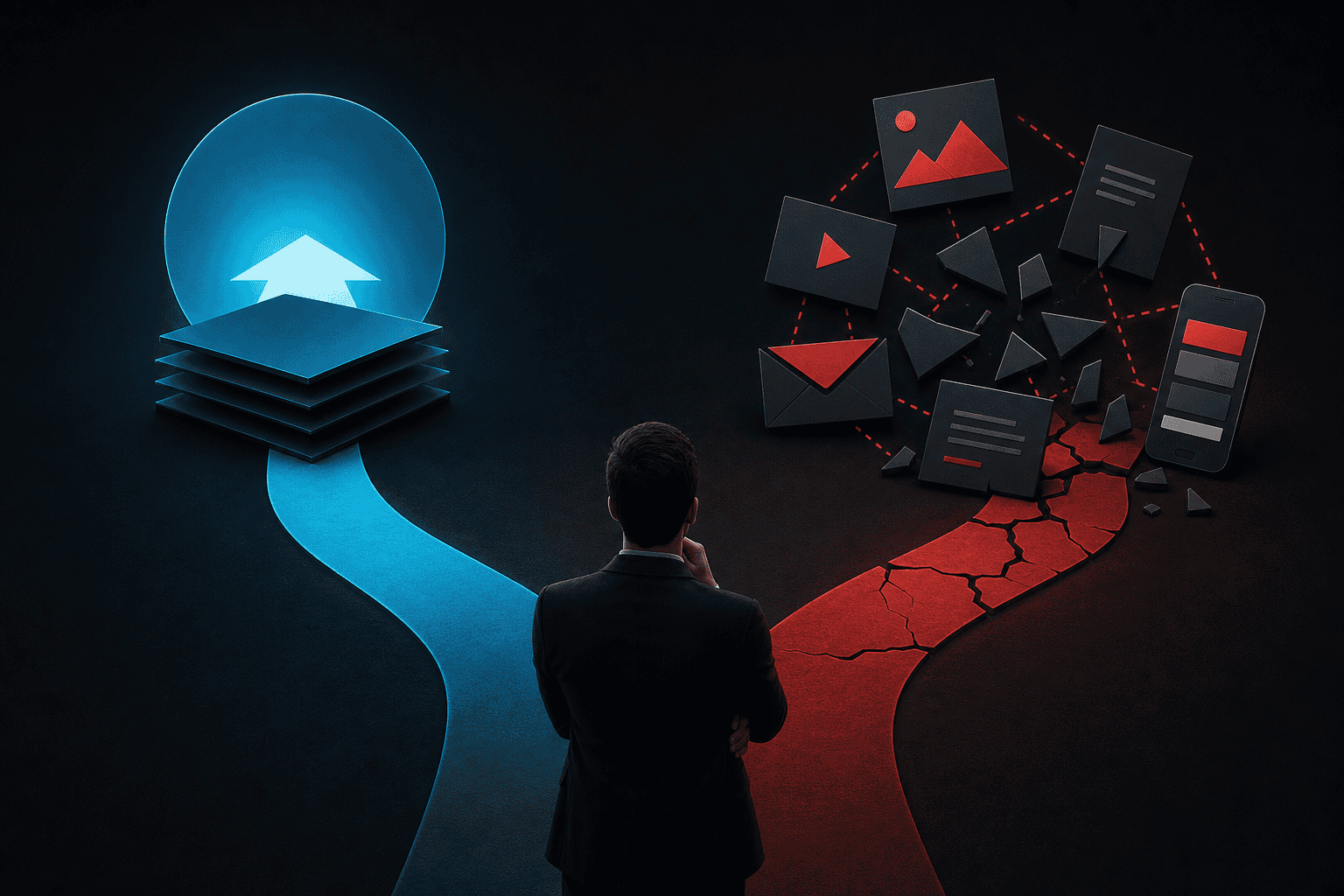
If you're somewhere in the middle, the piecemeal approach is the most dangerous option. A logo from one freelancer, a website from another, email templates from a third — the result is a brand that looks as disjointed as the process that made it. That fragmentation is expensive to fix later, and it costs you deals in the meantime.
The AI Factor in 2026
AI is reshaping what production design costs and how fast it moves. According to adapty.io, revenue for AI-driven graphics and design applications increased by 202% year-over-year in 2025. That shift is real, and it's compressing the price of production work.
What AI doesn't compress is the value of strategic decisions. Positioning, brand architecture, naming, the reasoning behind a visual system — these are judgment calls that require understanding your market, your audience, and your competitive context. Those decisions are what make AI-generated production assets coherent rather than generic. Strategy isn't a feature that AI adds to a subscription queue.
When a Fixed-Fee Scope Is the Right Answer
Growth-stage founders often approach this decision with a budget expectation shaped by subscription pricing. The monthly numbers look manageable. But the relevant comparison isn't monthly cost — it's total cost relative to outcome.
A fixed-fee engagement with a written scope means you know what you're spending and what you're getting. No open-ended monthly charges accumulating while the queue moves. There's a project, a deliverable, and a defined end. For a brand-building moment, that structure isn't just a preference. It's what makes the investment legible.
Splash Creative works with startups, consumer brands, and growing mid-market companies at exactly this stage. The studio's work includes Metabolik, a GLP-1 brand built on Shopify; Huug, a Shopify and Klaviyo build; and Coverwhale, a full rebrand from strategy to launch. These aren't production tasks. They're brand-defining moments that required a team with a scope, not a queue.
If you're at one of those moments, let's talk about your project.
Frequently Asked Questions
What is a design subscription service?
A design subscription service is a monthly recurring plan that gives you access to a design queue. You submit requests and a designer works through them one at a time. Services like ManyPixels, Penji, and Awesomic operate this way. They're built for ongoing production work, not brand strategy or systems-level design.
How does a design subscription service differ from a branding agency?
A subscription service provides production capacity on a monthly billing cycle with no defined project scope or endpoint. A branding agency delivers a scoped engagement — strategy, visual identity, and implementation as defined deliverables. The agency model is built for brand-building moments; the subscription model is built for production volume.
When should a startup use a design subscription instead of an agency?
A subscription service makes sense when a brand system is already in place and you need a steady stream of production assets. It's not the right fit for building a brand from scratch, launching a new product, or rebuilding a web presence. Those moments require strategy, not just execution.
Can a design subscription service build a Shopify store or set up Klaviyo?
No. Services like ManyPixels, Penji, and Awesomic are design production services only. They don't offer Shopify development or Klaviyo email setup. Those capabilities require a development and strategy layer that subscription services don't include.
How much does a full-service branding agency cost compared to a subscription?
Subscription services typically charge a few hundred to a few thousand dollars per month on an ongoing basis. A full-service agency engagement is a fixed-fee project. At Splash Creative, a logo and identity system starts around $15,000, and a full brand strategy plus identity plus website runs $40,000 to $75,000 or more. The comparison isn't monthly cost versus monthly cost — it's production capacity versus a defined brand outcome.
What is the "unlimited requests" model and what are its limits?
Most design subscription services advertise unlimited design requests, but practical throughput is one active task at a time. Complex deliverables take longer than simple ones, and the queue is the real constraint. Unlimited requests means you can submit as many as you want — not that they'll be completed quickly or simultaneously.
How has demand for design services changed in 2026?
According to themadbrains.com, search demand for hiring UI/UX designers increased by 300% between 2021 and 2026, while demand for graphic designers decreased by 9%. That shift reflects a broader move toward strategic and product design over pure production work — exactly the gap that a full-service agency is positioned to fill.