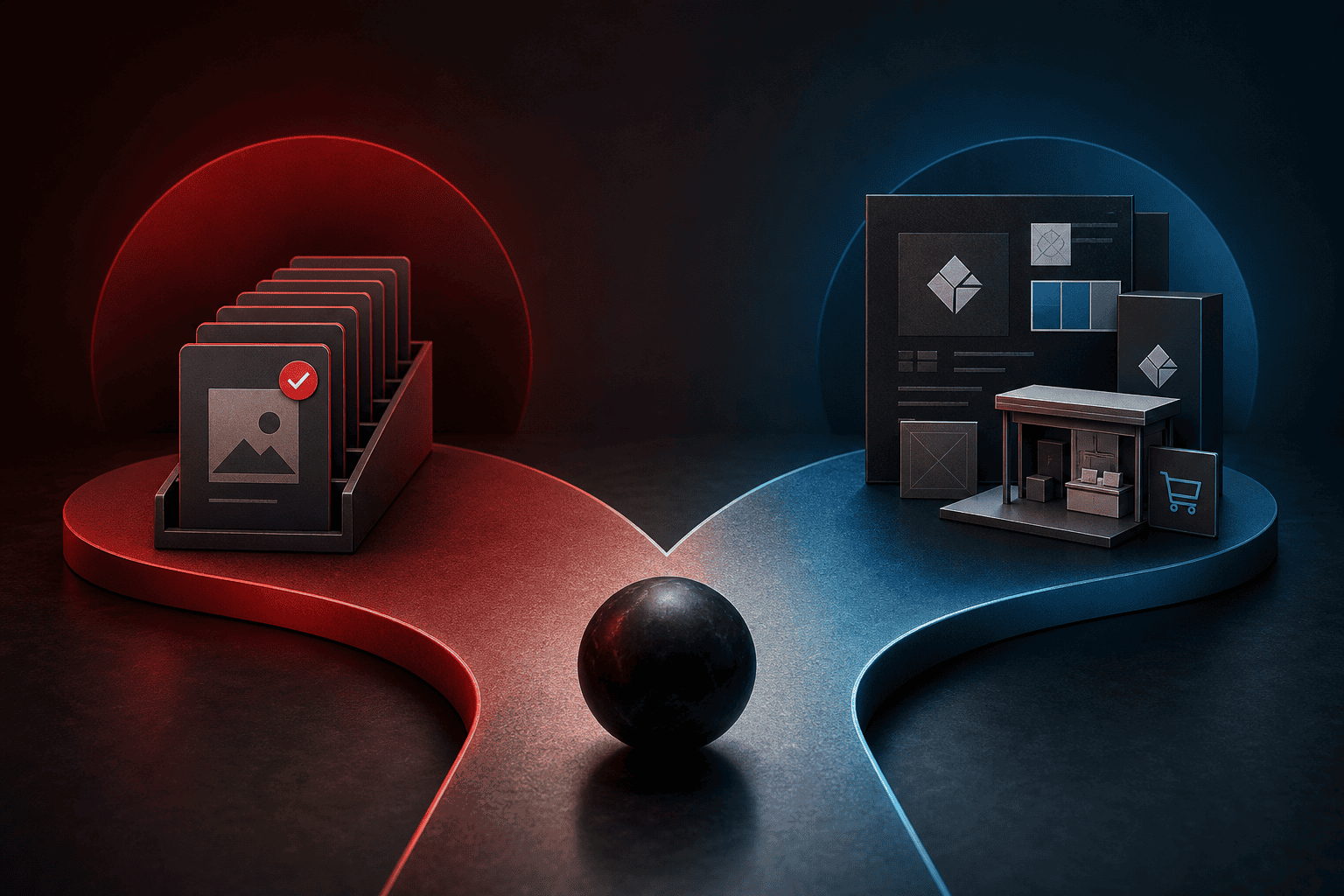
Branding Agency vs. In-House: An Honest Framework for Founders
This is not a sales pitch. There are real scenarios where building brand capability in-house is the smarter move. There are also real scenarios where hiring an agency is clearly correct. Most of the content that exists on this topic is written by agencies trying to sell you, or by in-house advocates with their own incentives. This article tries to be neither.
The goal here is a decision framework you can actually use, with honest criteria, realistic cost numbers, and a clear-eyed view of what each path actually requires.
When In-House Is the Right Answer
Let’s start here, because most agency-authored content skips this part entirely.
You are pre-product/market fit
If you have not yet found repeatable traction, investing in foundational brand strategy is almost certainly premature. Brand works best when it amplifies something that already resonates. If you are still iterating on what you are and who you serve, a brand system built today may be obsolete in nine months. Spend the energy on learning, not on brand polish.
You already have a senior brand or design leader on staff
If your team includes someone with genuine brand strategy experience, not just design execution, you may have everything you need internally. A seasoned VP of Brand or a founding creative director who has built identity systems before can run this process well. The key word is senior. A junior designer, however talented, does not fill this role.
You need ongoing high-volume creative production
Agencies are structured for project work. If your primary need is a constant stream of ads, social content, presentation templates, and sales collateral, a full-time in-house designer or small in-house team will almost always outperform an agency on speed, cost, and contextual knowledge. This is execution volume, not strategy, and in-house wins here.
Your budget is under $10,000
At this budget level, you are in freelance territory. A strong freelance designer can execute visual identity work competently. What you will not get at this budget, from any reputable agency, is a full positioning and brand strategy engagement. Know what you can actually buy before you start the conversation.
When Agency Is the Right Answer
You need positioning strategy, not just visual execution
This is the most common misunderstanding founders bring to branding decisions. They think they need a logo, a color palette, and a website. What they actually need, first, is clarity on who they are for, what they stand for, and how they are meaningfully different from the alternatives their buyers are considering. Visual execution follows from that work. An agency that does brand strategy builds the strategic foundation before opening a design tool. Most in-house teams, unless they have explicit strategy talent, skip this step or compress it.
You are doing a one-time foundational brand build
A foundational brand project has a beginning and an end. You are defining positioning, building a visual identity system, establishing a verbal identity, and creating brand guidelines. This is discrete, high-stakes work that benefits enormously from an outside process. Once it is built, you maintain and execute against it internally. Hiring a full-time brand person to do a project that takes four months and then leaves you with an ongoing salary commitment is poor allocation of capital.
You lack senior brand strategy talent in-house
If no one on your current team has done this specific type of work before, the risk of an in-house attempt is high. Brand decisions made without strategic grounding tend to be driven by personal taste, which produces inconsistency and usually requires a redo within two to three years. The cost of a weak brand built in-house often exceeds the cost of doing it right with an agency the first time.
You need it done in 8 to 16 weeks
A focused agency engagement can complete foundational brand strategy and identity in two to four months. An internal process, even with the right talent, typically takes longer because internal teams carry competing priorities, internal politics slow alignment, and there is no external accountability to a project timeline. If you have a launch, a raise, or a market entry with a real deadline, an agency structure is a meaningful advantage.
You need an outside perspective on how the market sees you
Founders are often the worst judges of their own brand. You are too close to the product, too invested in the origin story, and too fluent in your own internal language to see what a first-time visitor to your website actually experiences. A good agency brings genuine outside perspective, conducts real discovery, and tells you what is not working, including things you do not want to hear. This is one of the most undervalued things an agency delivers.
The Hybrid Model: What Most Successful Companies Actually Do
The false choice is agency versus in-house. The most common successful pattern is this: agency for foundational brand strategy and identity system, in-house for ongoing execution.
You hire an agency to do the hard strategic and structural work: positioning, messaging architecture, visual identity, brand guidelines. That work produces a system your internal team can operate within. Your in-house designer, or your content team, or your marketing manager then executes against that system at the speed and volume the business requires, without reinventing decisions every time.
This approach gets you the outside perspective and strategic rigor an agency provides, combined with the speed and contextual intimacy of an internal team. It also dramatically improves the quality of in-house output, because the team is executing within a clear and intentional system rather than making it up as they go.
What “In-House” Actually Requires That Founders Underestimate
When founders say they will handle branding in-house, they usually picture a designer on the team who can “take care of it.” That picture is almost always wrong. Here is what doing it well actually requires:
- A senior brand strategist, not just a graphic designer. These are different jobs. A graphic designer executes visual communication. A brand strategist defines positioning, architecture, and the strategic logic underneath the visuals. Many companies discover this distinction only after finishing a round of in-house work that looks fine but does not convert or differentiate.
- Three to six months of focused time. Real brand strategy is not a two-week sprint. It requires discovery, competitive analysis, stakeholder alignment, positioning development, identity exploration, and iteration. Compressing this process produces shallow results.
- Leadership alignment on positioning. The hardest part of brand work is not design. It is getting a founding team to agree on who you are for, what you are not, and what you are willing to walk away from. Without that alignment, every design decision becomes a proxy war for unresolved strategic disagreements. An outside agency facilitates this process neutrally. In-house teams rarely have the political standing to do it.
The Real Cost Comparison
Numbers matter here. Here is an honest breakdown:
- In-house brand hire: $90,000 to $150,000 per year, fully loaded. That includes salary, benefits, payroll taxes, equipment, and management overhead. If you need this person for three to four months to build a brand foundation and then transition to execution, you are still paying for the full year.
- Branding agency project: $15,000 to $75,000 as a one-time engagement, depending on scope, agency size, and deliverables. This covers strategy, identity, guidelines, and handoff. No ongoing overhead. No management burden. A clear end date.
- Freelancer: $5,000 to $20,000. This is execution only. A freelancer can produce visual assets, adapt templates, and execute within an existing system. A freelancer cannot typically do the positioning and brand strategy work that precedes design. If you know what you want and just need it made, freelance is a legitimate option. If you are trying to figure out what you want, it is not.
For a foundational brand build, the agency model is almost always more cost-efficient than a full-time hire. The hire makes sense when you have crossed into a phase where you need ongoing brand leadership and high-volume execution over years, not months.
The Questions That Actually Matter
Before making this decision, answer these honestly:
- Do I have someone on my team who has done foundational brand strategy work before, not just design?
- Is my business at a stage where brand will compound, or am I still finding product/market fit?
- Is this a one-time build or an ongoing execution need?
- Do I have the internal bandwidth and leadership alignment to run a three-to-six month brand process?
- Do I need an honest outside read on how the market perceives me?
If you answered no to the first, yes to the fourth question, or have a real deadline, an agency is almost certainly the right call. If you answered yes to the first and no to the rest, in-house may serve you well.
Making the Decision
There is no universal right answer, but there is usually a right answer for your specific situation. The most expensive mistake is not choosing the wrong path. It is choosing the wrong path and not knowing why the output is not working, which wastes another twelve to eighteen months before the course correction.
If you are weighing this decision seriously, it is worth understanding what a structured agency engagement actually looks like before ruling it out. You can read about how Splash structures brand engagements, or review what to look for in a branding agency if you are doing your due diligence across options. If you want a direct conversation about whether your situation is a fit for agency work, the best place to start is here.
Whatever you decide, make it a real decision with clear criteria, not a default driven by budget anxiety or founder instinct. Your brand is the context inside which every other marketing investment lives. It compounds when it is right, and it drags on everything when it is not.