- What 99designs Actually Is (and Does Well)
- What Gets Missed Without Brand Strategy
- The One-Deliverable-at-a-Time Problem
- What a Full-Service Studio Engagement Looks Like
- Side-by-Side: 99designs vs. Full-Service Studio
- When 99designs Makes Sense
- When a Full-Service Studio Makes Sense
- The Real Cost of Logo Design (Beyond the Contest Fee)
- A Note on Other Alternatives
- FAQs
- The Right Tool for the Right Stage
You found 99designs. You saw the logo contest starting at $299. You thought: maybe this is the move.
It might be. Or it might cost you more than you think — not in dollars, but in time, consistency, and the brand equity you're trying to build.
Here's an honest comparison. Not a takedown of 99designs, but a clear-eyed look at what each option actually delivers, what each one misses, and how to figure out which one fits where you are right now.
What 99designs Actually Is (and Does Well)
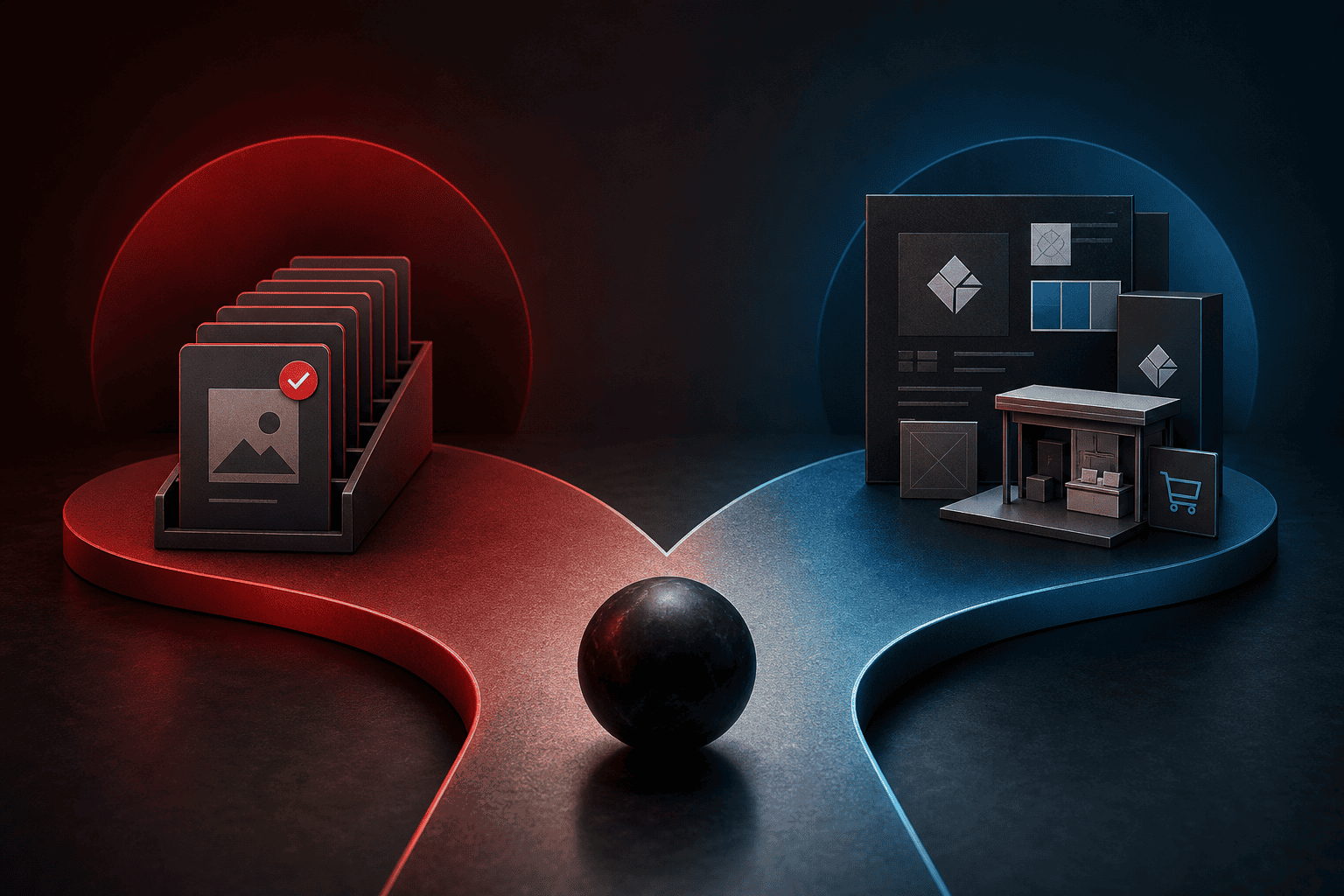
99designs is a crowdsourced design marketplace. You post a brief, designers from around the world submit concepts, you pick a winner and pay. Logo contests start at $299. You can also hire a designer directly through the platform for a one-off project.
It works well in specific situations:
- You need a single deliverable fast — a logo, an icon, a social media graphic
- Your budget is genuinely tight and you're comfortable with the tradeoff
- You have a strong internal sense of what you want and can direct designers clearly
- You're pre-revenue and testing a concept before committing to a full brand
The crowdsourced model has real advantages: speed, volume of concepts, and a low financial floor. If you need a logo for a side project or a proof-of-concept, 99designs can get you there.
What the $299 price tag doesn't include: strategy, brand guidelines, a website, email marketing, or any connective tissue between deliverables.
What Gets Missed Without Brand Strategy
A logo is not a brand. Most founders don't feel that distinction until they're six months post-launch and their Shopify store looks like it belongs to a different company than their email campaigns.
Brand strategy answers questions that design can't answer on its own:
- Who is this brand for, specifically?
- What does it stand for — and what doesn't it stand for?
- How should it sound, not just look?
- What visual system scales from a product label to a pitch deck to a paid ad?
When you skip strategy and go straight to a logo contest, you get a mark. You don't get a system. The designer submitting to your 99designs contest doesn't know your competitive positioning, your target customer's psychology, or what your brand needs to communicate to a Series A investor versus a first-time buyer.
That gap shows up later. In inconsistent social content. In a website that feels disconnected from your packaging. In brand guidelines that don't exist, so every new hire or freelancer interprets the brand differently.
The cost of that inconsistency is real. It erodes trust with your audience and makes every subsequent design project harder and more expensive to fix.
The One-Deliverable-at-a-Time Problem
99designs is built around individual deliverables. You run a logo contest. Then you find a web designer. Then someone for email templates. Then someone for your pitch deck.
Each handoff is a risk. Each new designer reinterprets your brand. The logo winner doesn't know what the web designer is building. The email designer has never seen your brand guidelines — because they don't exist in a usable format.
This is how brands end up looking like four different companies across four different channels. It's not a failure of any individual designer. It's a structural problem with the one-deliverable-at-a-time model.
For a startup preparing for a launch, a rebrand, or a fundraise, that fragmentation is expensive. Investors notice when a brand feels unfinished. Customers notice when the experience feels inconsistent. And you end up spending more fixing the patchwork than you would have spent doing it right the first time.
What a Full-Service Studio Engagement Looks Like
A full-service branding studio handles the entire system in one engagement. Strategy informs identity. Identity informs the website. The website and brand guidelines inform email design. Everything works together because it was built together.
At Splash Creative, a branding project starts at $15,000 for a logo and identity system. A full engagement covering brand strategy, identity, and website runs $40,000 to $75,000 and above. Every project is fixed-fee and scoped in writing before kickoff — no hourly billing, no surprises.
That scope document is what makes the engagement work. You know exactly what you're getting, what the timeline looks like, and what it costs. There's no open-ended billing that grows as the project evolves.
The studio has worked with brands across CPG, health and wellness, and direct-to-consumer — including Metabolik (GLP-1 brand and Shopify implementation), Huug (Shopify and Klaviyo e-commerce design and email automation), and Coverwhale (full rebrand from strategy to launch). These aren't logo projects. They're brand systems built to perform across every channel a growing company touches.
Side-by-Side: 99designs vs. Full-Service Studio
| 99designs | Full-Service Studio | |
|---|---|---|
| Starting price | $299 (logo contest) | $15,000 (logo + identity system) |
| Brand strategy | No | Yes |
| Logo + identity system | Logo only | Full system |
| Brand guidelines | Basic file delivery | Comprehensive guidelines |
| Website design/build | No | Yes (Shopify, custom, landing pages) |
| Email marketing | No | Yes (Klaviyo strategy, design, automation) |
| Fixed-fee scoping | Per contest | Yes, scoped in writing |
| Strategic oversight | No | Yes |
| Best for | Single deliverables, early-stage | Launch, rebrand, fundraise |
When 99designs Makes Sense
Here's the honest part. 99designs isn't the wrong answer for every situation.
If you're pre-revenue and need a placeholder logo to test a concept, $299 is a reasonable experiment. If you need a quick icon or a one-off graphic and have no design resources, the marketplace can work.
The problem is when founders use 99designs at the wrong stage. If you're raising money, launching a product to a real audience, or competing in a category where brand perception drives purchasing decisions, a logo contest isn't the right tool. The stakes are too high and the output is too narrow.
When a Full-Service Studio Makes Sense
You need a full-service studio when the brand has to work across multiple channels and the cost of inconsistency is real.
If any of these apply to you, it's worth the conversation:
- You're preparing for a launch and need a brand system, not just a logo
- You're rebranding after outgrowing a DIY or freelancer-built identity
- You're fundraising and your brand needs to hold up in front of investors
- You're running a Shopify store and your email, website, and brand feel disconnected
- You've hired multiple freelancers and nothing looks like it belongs together
At that stage, the question isn't whether you can afford a full-service studio. It's whether you can afford not to have one.
The Real Cost of Logo Design (Beyond the Contest Fee)
When founders ask how much logo design should cost, they're often asking the wrong question. The right question is: what does the logo need to do?
A $299 logo from a contest might work fine as a standalone mark. But if you need it to anchor a brand system that scales across a website, packaging, email campaigns, pitch decks, and social media, that $299 mark is just the start of a much longer and more expensive process.
A logo and identity system from a full-service studio costs more upfront — but it includes the brand guidelines, color system, typography, and usage rules that make every subsequent design project faster and cheaper. You're not rebuilding the foundation every time you need a new asset.
A Note on Other Alternatives
If you're looking beyond 99designs, a few other categories are worth understanding.
Subscription design services like ManyPixels and Penji start around $499 to $500 per month. They're production services, not strategic partners — no brand strategy, no Shopify builds, no Klaviyo integration, and no defined project endpoint. Useful for ongoing asset production if you already have a strong brand foundation. Not useful for building one from scratch.
Superside serves enterprise teams at $10,000 to $100,000 per month. The quality is high, but the price point is out of reach for most seed-to-Series-A founders.
Klaviyo-specialist agencies don't handle brand identity or web design. Shopify design agencies don't handle brand strategy or email. If you need all three, you're looking at three separate vendors, three separate scopes, and three separate invoices — unless you find a studio that handles all of it in one engagement.
FAQs
Is 99designs good for startups?
It depends on the stage. 99designs works well for pre-revenue founders who need a placeholder logo quickly and cheaply. For startups preparing to launch, rebrand, or fundraise, the one-deliverable-at-a-time model typically creates brand inconsistency that costs more to fix than a full-service engagement would have cost upfront.
How much should a startup spend on logo design in 2026?
A logo-only project from a full-service studio starts around $15,000 and includes a complete identity system with brand guidelines. A logo contest on 99designs starts at $299 but delivers a mark without strategy, guidelines, or a system that scales. The right answer depends on what the logo needs to do and what stage your company is at.
What does a full-service branding studio do that 99designs doesn't?
A full-service studio handles brand strategy, visual identity, website design and development, and email marketing in a single coordinated engagement. 99designs covers one deliverable at a time — no strategy layer, no brand guidelines system, no web builds, no email marketing.
What is a good 99designs alternative for a growing startup?
A full-service branding studio is the most direct alternative when you need more than a logo. Studios like Splash Creative bundle brand strategy, identity, Shopify development, and Klaviyo email setup into a single fixed-fee engagement — which solves the fragmentation problem that comes with using multiple vendors or a crowdsourced marketplace.
How long does a full-service branding project take compared to a 99designs contest?
A 99designs logo contest typically runs seven days. A full-service branding engagement covering strategy, identity, and website takes longer because it covers significantly more ground. The tradeoff is a complete, strategic brand system versus a single deliverable.
What is included in brand guidelines?
Brand guidelines document your logo usage rules, color palette, typography system, imagery direction, and tone of voice. They give every designer, marketer, or vendor who touches your brand a consistent reference point. 99designs delivers design files. A full-service studio delivers the guidelines that make those files usable at scale.
Do I need a Shopify build and Klaviyo setup as part of my branding project?
Not always — but if you're a direct-to-consumer or e-commerce brand, having your Shopify store and Klaviyo email flows built to match your brand identity from the start saves significant time and money later. Building them separately with different vendors is the most common source of brand inconsistency for growing e-commerce companies.
The Right Tool for the Right Stage
99designs is a tool. It does one thing reasonably well: deliver a logo concept quickly at a low price point. If that's what you need, use it.
But if you're building a brand that needs to perform across a website, email campaigns, social media, and investor materials, you need more than a logo. You need a system — and someone who can build all of it in one place.
If that's where you are, let's talk about your project.