Table of Contents
- Why This Question Matters
- What Is a Logo?
- What Is a Full Brand Identity?
- Logo vs. Brand Identity: Side-by-Side Comparison
- Common Mistakes Businesses Make
- Which One Do You Actually Need?
- What the Build Process Looks Like
- FAQs
- Build a Brand Worth Remembering
Why This Question Matters
When founders and marketing leads kick off a new venture or rebrand, the first ask is almost always "we need a logo." Makes sense — a logo is tangible, visible, and feels like real progress.
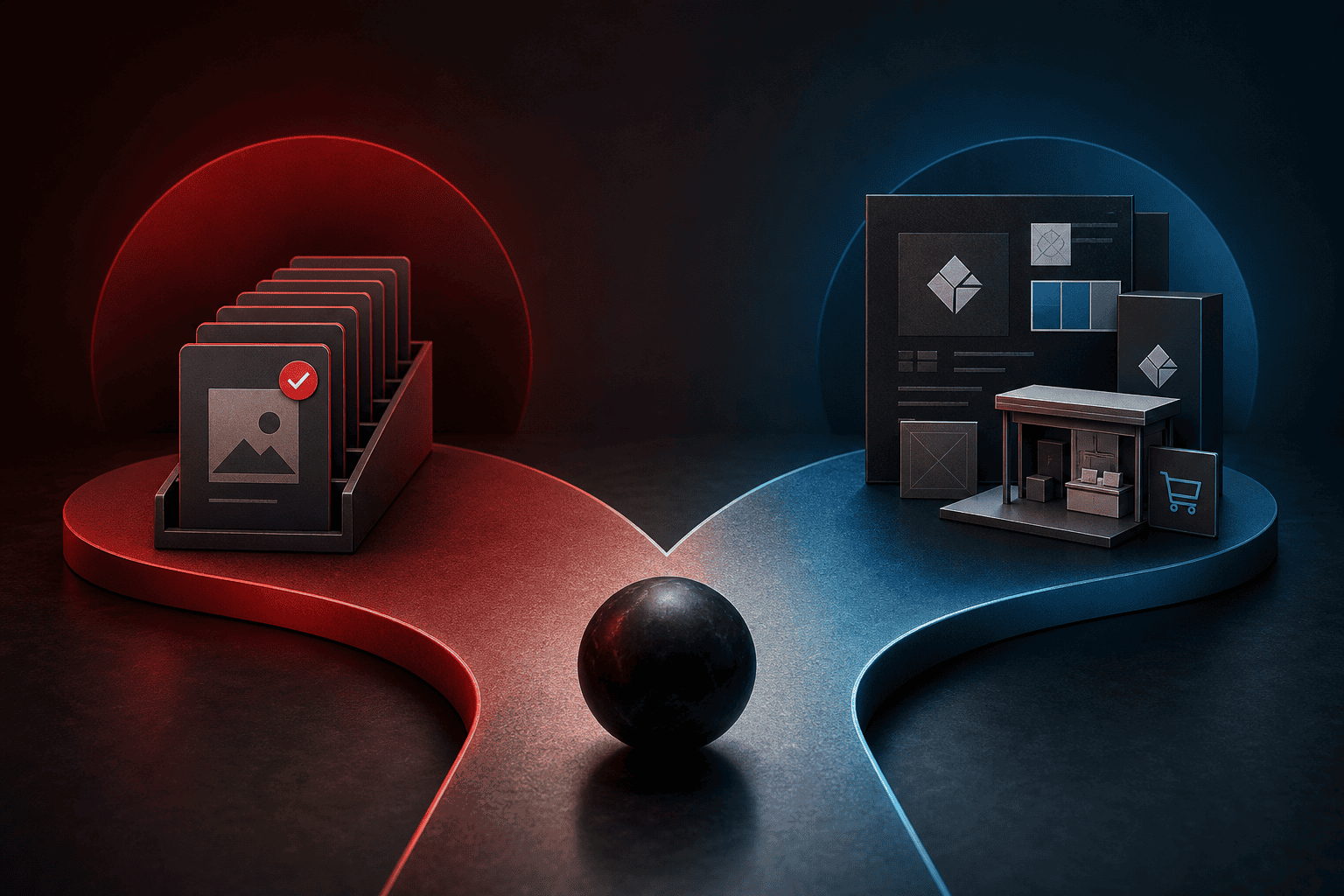
But a logo alone won't tell your story. It won't build trust with customers or give your team a consistent visual language to work from. That's what a brand identity does.
The difference between the two isn't a design technicality — it's a business decision. Get it wrong and you end up spending twice: once on a logo, and again when you realize you need everything around it. This article breaks down what each one actually includes and how to figure out which one your business needs right now.
What Is a Logo?
A logo is a mark. It's the symbol, wordmark, or combination of both that represents your business visually — think of it as your brand's signature.
A good logo is clean, scalable, and memorable. It works in black and white, looks sharp on a business card, and holds up at banner size. That's the craft behind it.
What a logo is not, though, is your brand. It doesn't define your typography, your color palette, your tone of voice, or how your business shows up across a website, a pitch deck, or a social post. A logo is one piece of a much larger system.
What Is a Full Brand Identity?
A brand identity is the complete visual and verbal system that defines how your business looks, sounds, and feels across every touchpoint.
It starts with strategy — who you are, who you serve, what makes you different — and builds a framework that expresses all of that clearly and consistently.
What a Brand Identity System Includes
A full brand identity typically covers:
- Logo suite — primary logo, secondary mark, icon or favicon variant
- Color palette — primary and secondary colors with exact hex, RGB, and CMYK values
- Typography — heading and body typefaces, hierarchy rules, and usage guidelines
- Brand voice and messaging — tone, taglines, positioning statement, and key messages
- Graphic elements — patterns, textures, icons, and supporting visual devices
- Photography and imagery direction — what kinds of images fit your brand and which don't
- Brand guidelines document — the rulebook that keeps everything consistent, whether it's your internal team or an outside vendor working with your assets
This is the system that makes your brand recognizable whether someone lands on your website, picks up your packaging, opens an email, or sees one of your ads.
Logo vs. Brand Identity: Side-by-Side Comparison
| Logo Design | Full Brand Identity | |
|---|---|---|
| What it is | A single visual mark | A complete visual and verbal system |
| What's delivered | Logo files (SVG, PNG, etc.) | Logo suite, color palette, typography, voice, guidelines |
| Strategic depth | Minimal | High |
| Use case | Early-stage or simple needs | Growth-stage, rebrand, or market launch |
| Consistency across channels | Limited | Built for it |
| Timeline | Shorter | Longer |
| Investment | Lower | Higher |
| Longevity | May need updating as brand evolves | Designed to scale with the business |
Common Mistakes Businesses Make
Treating a logo as a brand. A startup lands a great logo, then uses three different fonts across their website, pitch deck, and social media. Each piece might look fine on its own — but together, the brand feels scattered and unprofessional.
Building identity assets piecemeal. One freelancer handles the logo, another builds the website, someone else designs the social graphics. Everyone makes their own calls. Nothing coheres. You end up with a visual identity that looks like it was designed by a committee that never met.
Skipping strategy. Some businesses jump straight into visual design without doing the positioning work first. The result is a brand that looks polished but doesn't actually say anything specific or meaningful to the right audience.
Waiting too long to build the full system. A lot of businesses put off brand identity work until they feel "big enough." But the longer you wait, the more inconsistent assets pile up — and the harder they are to untangle later.
Which One Do You Actually Need?
It comes down to where your business is and what you're trying to accomplish.
Start with a Logo If…
- You're pre-launch and testing a concept before committing to a full brand
- Budget is tight and you need something functional fast
- You already have a brand system in place and just need a mark refresh
- You're building an internal tool or product that won't face heavy public scrutiny yet
A standalone logo makes sense when speed and cost are the priority and the stakes are still low.
Invest in Full Brand Identity If…
- You're launching into a competitive market
- You've raised funding and need to look credible to investors, partners, and customers
- You're rebranding a business that has outgrown its current look
- You have a team that needs consistent assets to work from
- You're building a website, running ads, or creating marketing materials — anything that requires your brand to show up in multiple places at once
If your brand needs to do real work — attract customers, build trust, support a sales process — you need the full system.
What the Build Process Looks Like
At Splash Creative, brand identity isn't a logo handoff with a PDF attached. It's a strategic process.
It starts with understanding your business: your positioning, your audience, your competitors, and what you want people to feel when they encounter your brand. That thinking shapes every visual and verbal decision that follows.
From there, the work moves through concept development, design refinement, and delivery of a complete system — logo suite, color palette, typography, voice guidelines, and a brand standards document your whole team can actually use.
Because Splash Creative handles strategy, design, copy, and development under one roof, the brand identity you build carries directly into your website, your marketing materials, and your content — no handoff chaos, no vendor juggling. You can see how that plays out in their portfolio, with projects spanning insurance, healthcare, and consumer brands.
FAQs
Q: Can I get a logo now and build out the full brand identity later?
A: Yes, but plan for it intentionally. Make sure the logo is designed with room to grow — flexible enough to anchor a larger system when you're ready. Retrofitting a brand identity around a logo that wasn't built for it can be limiting.
Q: How long does a full brand identity project take?
A: It depends on scope and how quickly decisions get made, but a thorough brand identity project typically runs four to eight weeks. Rushing it usually means skipping the strategy work, which defeats the purpose.
Q: What's the difference between brand identity and brand strategy?
A: Brand strategy is the thinking — your positioning, your audience, your differentiation, your messaging framework. Brand identity is the expression of that thinking through visuals and voice. Good identity work starts with strategy. You can't design your way out of a positioning problem.
Q: Do I need brand guidelines if I'm a small business?
A: Yes. Even a one-page guide covering your logo, colors, and fonts saves time and keeps things consistent as you grow. The bigger your team or vendor list gets, the more valuable a clear set of guidelines becomes.
Q: What does a brand identity project typically cost?
A: It varies based on scope and who you work with. Premium agencies can charge $50K or more. Subscription design services offer limited strategic depth. Mid-market studios like Splash Creative sit in between — delivering strategic, polished work at a more accessible price point.
Q: Can one agency handle both brand identity and my website?
A: That's actually the ideal setup. When your brand identity and website are built by the same team, the visual language stays consistent and the transition from design to development is seamless. Splitting those projects across different vendors almost always creates friction.
Q: How do I know if my current brand needs a full rebrand vs. a refresh?
A: A refresh makes sense when your core identity is solid but looks dated or inconsistent. A full rebrand is worth considering when your positioning has shifted, you've entered a new market, or your current brand no longer reflects who you are or who you serve.
Build a Brand Worth Remembering
A logo gets you in the door. A full brand identity keeps you in the room.
If you're building something serious — a funded startup, a growing business, a product that needs to earn trust fast — a complete brand identity system is one of the smartest early investments you can make.
Great brands aren't born. They're built, deliberately, with strategy behind every decision.
Ready to build yours? Learn more at splashcreative.com or reach out to start a conversation about your project.